How to Read an Insulin Syringe: Units, Lines and Sizes Explained
Key Takeaways
- A U-100 insulin syringe holds 100 units in 1 mL, so 1 unit equals 0.01 mL.
- Read your dose at the flat top edge of the plunger's rubber tip, the edge closest to the needle.
- Pick the smallest syringe that holds your full dose. Smaller barrels space the lines farther apart.
- Your syringe must match your insulin strength. U-500 insulin needs its own U-500 syringe.
Every insulin syringe is marked in units, not milliliters, and each line on the barrel equals half, one, or two units depending on its size. Reading those lines correctly is the difference between your prescribed dose and a dangerous mistake. Here's how to read an insulin syringe, pick the right size, and measure each dose with confidence.
What Do the Lines on an Insulin Syringe Mean?
The insulin syringe lines measure insulin units, the same units your doctor uses to write your dose. Most insulin sold in the US is U-100, which means 100 units in every milliliter, so most syringes are U-100 insulin syringes.
An insulin syringe has three parts:
- Barrel: the clear tube printed with the scale.
- Plunger: the rod you pull back to draw insulin in. Its black rubber tip is what you read against the scale.
- Needle: a short, thin needle fixed to the tip, covered by a cap.
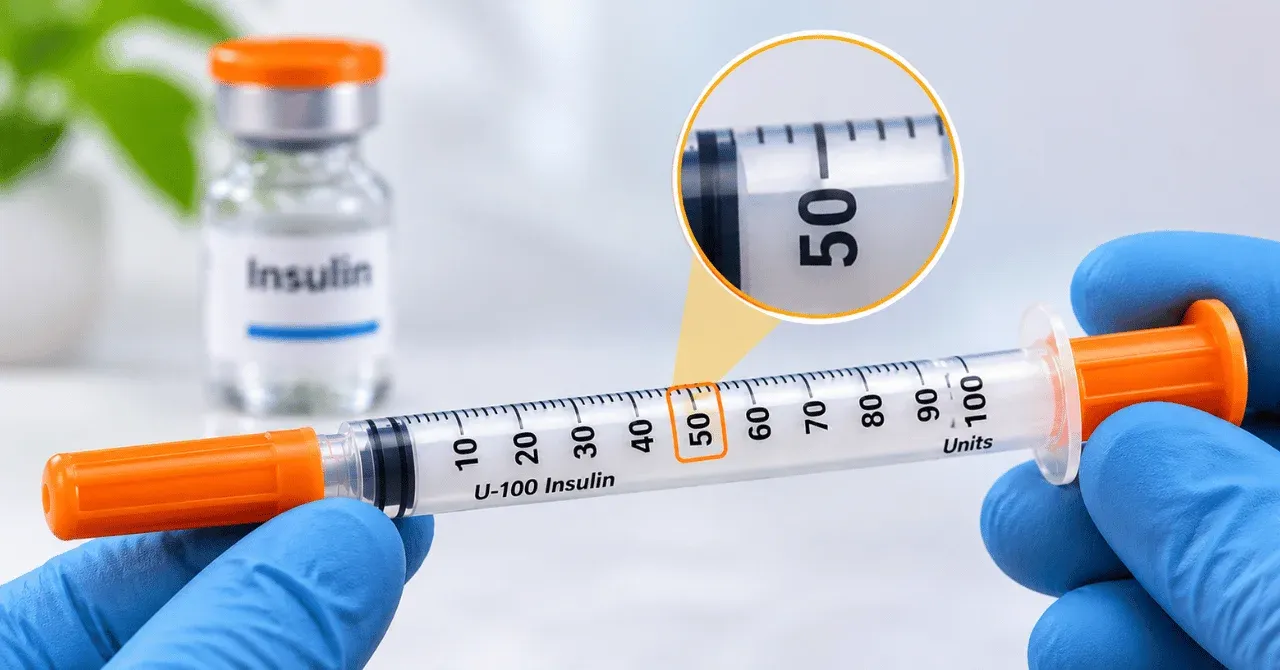
The long lines carry numbers, usually every 5 or 10 units. The short lines between them are the smaller insulin syringe units. Count the short lines between two numbers to find out what each one is worth on your syringe.
Where to Read the Dose
Hold the syringe upright at eye level. Read the dose at the flat top edge of the rubber plunger tip, the edge nearest the needle. Do not read from the bottom of the rubber tip or from the pointed center of the plunger, because that adds units you did not intend. If the markings are hard to see, a clip-on syringe magnifier can help.
Insulin Syringe Sizes: Which One Fits Your Dose?
Insulin syringe sizes come in three common barrels, and all three use the same U-100 scale. A smaller barrel spreads the same units over a longer length, which makes small doses easier to read.
| Syringe Size | Holds Up To | Each Small Line Usually Equals | Best For |
|---|---|---|---|
| 0.3 mL | 30 units | 1 unit (some brands also mark half units) | Doses of 30 units or less |
| 0.5 mL | 50 units | 1 unit | Doses of 31 to 50 units |
| 1 mL | 100 units | 2 units | Doses of 51 to 100 units |
← Swipe to see more →
A 0.3 mL insulin syringe is the usual choice for children and anyone who takes small or half-unit doses. If your dose is an odd number, such as 23 units, a 1 mL syringe with 2-unit lines makes it hard to measure exactly, so a smaller barrel is the safer pick.
Converting Units to mL
On a U-100 syringe, divide the units by 100 to get milliliters. So 5 units is 0.05 mL, 10 units is 0.1 mL, 25 units is 0.25 mL, and 50 units is 0.5 mL. This units-to-mL rule only works for U-100 insulin. Concentrated insulins such as U-200 or U-500 hold more units in each milliliter.
How to Read a 1 mL Syringe
First, check which kind of 1 mL syringe you have, because two kinds look almost the same:
- 1 mL insulin syringe: marked in units from 0 to 100, usually with a number every 10 units and a short line every 2 units. To draw 36 units, pull the plunger tip to the third short line above 30.
- Standard 1 mL syringe (often called a tuberculin syringe): marked in milliliters from 0 to 1, with a number every 0.1 mL. The short lines are usually 0.01 mL each, though some brands mark every 0.02 mL. To draw 0.24 mL, stop the plunger tip at the fourth short line above 0.2.
Read both kinds the same way, at the top edge of the plunger tip with the syringe at eye level. Use the scale your prescription is written in. If your insulin dose is in units, use an insulin syringe, not a standard mL syringe.
How to Draw Up Insulin and Measure Your Dose
Reading the syringe is only half the job. The way you fill it decides whether the number you read is the dose you get.
- Check your supplies: Wash your hands. Confirm the insulin name, expiration date, and strength, and make sure your syringe matches it (a U-100 syringe for U-100 insulin).
- Prepare the bottle: If your insulin is cloudy, roll the bottle gently between your hands to mix it. Wipe the rubber top with an alcohol pad.
- Add air: Pull the plunger back to your dose to fill the syringe with air. Push the needle through the rubber top and press the air into the bottle.
- Draw the insulin: Turn the bottle upside down with the needle tip in the liquid. Pull the plunger back to your dose.
- Remove air bubbles: Tap the syringe so the bubbles float to the top, push them back into the bottle, then pull back to the right dose again. Bubbles take up space that should hold insulin.
- Recheck before you inject: With the needle still in the bottle, hold the syringe at eye level and confirm the top edge of the plunger tip sits on your dose line.
If your doctor tells you to mix two insulins in one syringe, draw the short-acting insulin first, then the longer-acting one. Add the two doses together to find the total line to stop at. Never push mixed insulin back into either bottle, so draw the second insulin slowly.
Common Syringe Mistakes That Lead to Wrong Doses
Most dosing errors come from a mismatch between the syringe, the medicine, and the way the dose is written. Watch for these three.
Using a Syringe That Doesn't Match Your Insulin Strength
U-500 insulin is 5 times more concentrated than U-100. In 2016, the FDA approved a dedicated U-500 syringe, which is now the only device approved for drawing doses from a Humulin R U-500 vial. Before that, patients had to convert doses using U-100 or standard syringes, which led to errors. U-500 syringes need a prescription, and the FDA advises keeping a steady supply rather than switching between syringe types.
The same risk applies to U-40 syringes, which are sometimes used for pet insulin. Drawing U-100 insulin to the 40 mark on a U-40 syringe gives a full 1 mL, which is 100 units, or 2.5 times the intended dose.
Measuring Insulin With a Standard mL Syringe
A standard syringe forces you to convert units to milliliters every time, and one misplaced decimal means a tenfold error. Unless your doctor writes your dose in milliliters, use an insulin syringe whose scale matches your prescription.
Confusing Units and Milligrams With GLP-1 Vials
This mistake shows up with weight loss drugs. In July 2024, the FDA warned that people using compounded semaglutide from multiple-dose vials were drawing the wrong amount into insulin syringes. In several reports, patients told to draw 5 units (0.05 mL) drew 50 units instead. Measurement errors led to doses five to 20 times higher than intended, and some people needed hospital care.
FDA-approved semaglutide avoids this problem because it comes as prefilled pens dosed in milligrams or as tablets, so there is no syringe to read. Health Canada-approved generic semaglutide pens are prefilled pens too. Our guide to generic vs. compounded semaglutide explains the difference.
Three Checks Before Every Insulin Shot
Learning how to read an insulin syringe comes down to three checks: the syringe matches your insulin strength, the barrel is the smallest one that fits your dose, and you read the top edge of the plunger tip at eye level. Do those every time, and the number on the barrel will match the dose your doctor prescribed.
Polar Bear Meds ships insulin vials from Canada, including Humulin R, Humulin N, Humalog, and Novolin GE Toronto. Browse all insulin and diabetes supplies, and have a valid prescription ready when you order.
Frequently Asked Questions
No. On U-100 insulin, 1 unit is just 0.01 mL, and a full milliliter holds 100 units. Mixing up the two would mean a dose 100 times too large.
Use a 0.3 mL syringe with half-unit markings, where each short line between the whole numbers equals half a unit. Some insulin pens can also dial half units. Ask your doctor which option fits your dose before you switch.
No. Insulin pens use screw-on pen needles, such as the BD Nano pen needle, and you set the dose on the pen's dial. You never read a barrel scale with a pen.
Put each used syringe straight into a sharps container right after your shot. Pharmacies sell FDA-cleared containers. If you don't have one, the FDA says a heavy-duty plastic household container, such as a laundry detergent bottle, can work. Never put loose needles in the trash or recycling, and never flush them.
Disclaimer
This article is for informational purposes only and is not a substitute for medical advice. Always follow the dose and syringe type your doctor or pharmacist gives you, and ask them to show you how to draw up your insulin if you are unsure.