ACA GLP-1 Coverage Self-Employed: What Freelancers and Contractors Need to Know in 2026
Key Takeaways
1. Only 26 of 300 ACA marketplace carriers cover GLP-1s for obesity treatment in 2026, according to Becker's Payer.
2. Prior authorization is required by every plan that does offer coverage, with strict BMI and lifestyle documentation requirements.
3. In 2026, HSA contribution limits are $4,400 for self-only HDHP coverage and $8,750 for family HDHP coverage.
4. Some patients consider compounded GLP-1 products when insurance will not cover brand-name medications, but FDA warns that these products are not FDA-approved and may carry safety, quality, and dosing risks.
ACA GLP-1 coverage self-employed individuals can access is narrower than most people expect. For anyone comparing GLP-1 coverage ACA 2026 options, the biggest issue is whether the plan treats obesity drugs differently from diabetes medications. In 2026, the majority of ACA marketplace plans exclude GLP-1 medications for weight loss entirely, leaving freelancers and independent contractors to navigate a system that wasn't designed with their situation in mind. This article details coverage, costs, and opportunities.
The GLP-1 Coverage Gap: Why Most ACA Plans Won't Pay for Weight Loss Drugs in 2026
The numbers are stark. Out of 300 carriers offering marketplace plans in 2026, only 26 cover GLP-1 medications for obesity treatment, according to Becker's Payer. That's less than 9% of carriers. Becker’s Payer reported that only 26 of 300 marketplace carriers offered GLP-1 obesity coverage for 2026. That makes health insurance for obesity drugs especially difficult for freelancers, contractors, and any independent contractor buying coverage without an employer plan.
Coverage has also been moving in the wrong direction. Enrollment in plans covering GLP-1s for weight loss dropped from 3.6 million in 2024 to 2.8 million in 2026, a meaningful decline in just two years.
A critical distinction to understand is that marketplace health plans GLP-1 coverage for diabetes-approved drugs like Ozempic (semaglutide) and Mounjaro (tirzepatide) is more commonly available than coverage for medications approved solely for weight management, like Wegovy and Zepbound. If you have Type 2 diabetes, your plan formulary may already include a GLP-1. If you're seeking one purely for obesity, the door is much narrower.
An exception is the FDA expanded the Wegovy label in 2024 for cardiovascular risk reduction, and some marketplace plans may cover it for that specific indication, even if they exclude it for general weight management.
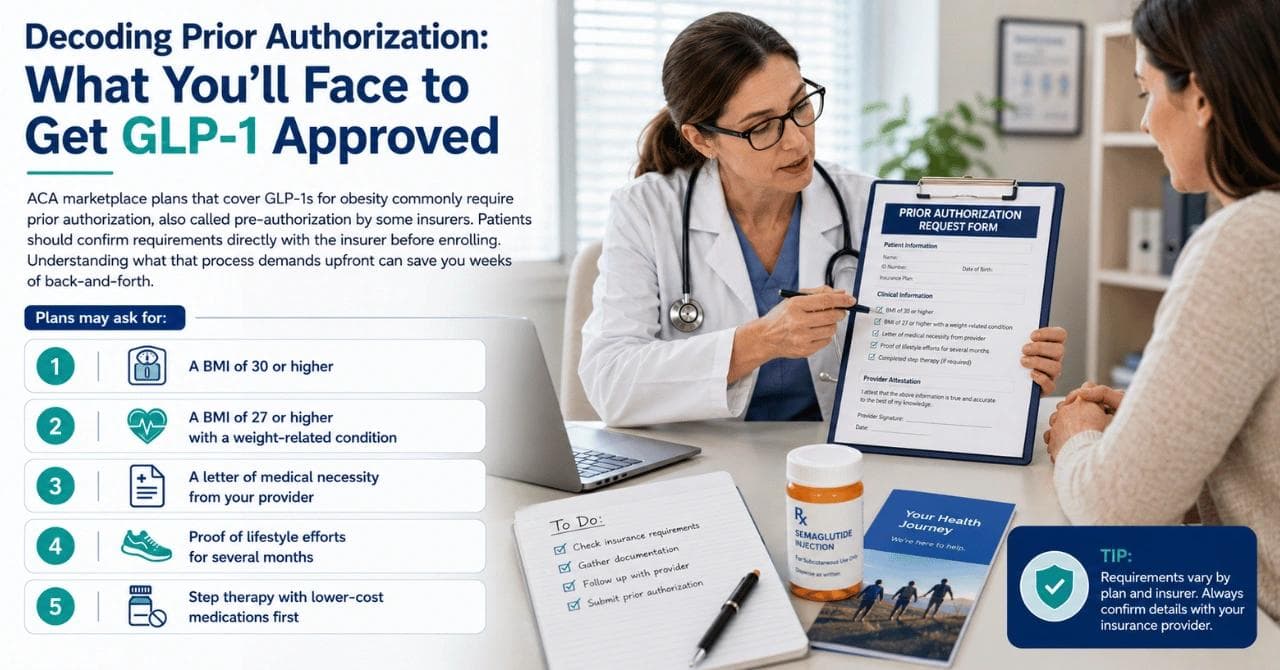
Decoding Prior Authorization: What You'll Face to Get GLP-1 Approved
ACA marketplace plans that cover GLP-1s for obesity commonly require prior authorization, also called pre-authorization by some insurers. Patients should confirm requirements directly with the insurer before enrolling. Understanding what that process demands upfront can save you weeks of back-and-forth.
Plans may ask for:
1. A BMI of 30 or higher
2. A BMI of 27 or higher with a weight-related condition
3. A letter of medical necessity from your provider
4. Proof of lifestyle efforts for several months
5. Step therapy with lower-cost medications first
That's just the starting point. Some plans require documented lifestyle efforts before approval, often for several months. You're essentially proving you've already tried the cheaper path.
Step therapy adds another layer. Many plans require patients to fail lower-cost medications before a GLP-1 agonist gets approved. If you're just beginning this process, expect a timeline measured in months, not weeks.
The Real Cost of GLP-1 Medications with ACA Insurance
High deductibles are the first wall you'll hit. Your premium, deductible, subsidy, and drug tier can all change the real monthly cost. Many ACA marketplace plans have high deductibles, so patients may still pay substantial out-of-pocket costs before coverage begins. That means the first several months of a GLP-1 prescription may be entirely out-of-pocket, regardless of what your plan technically covers.
The Obamacare GLP-1 cost picture gets complicated once you clear that hurdle. Brand-name GLP-1 medications list at over $1,000 per month without insurance. With approved coverage, monthly costs can drop to between $25 and $300, but that range depends heavily on which formulary tier your plan places the drug. Copays and coinsurance vary by formulary tier, deductible status, and plan design.
The math is real. Coverage helps significantly, but getting there requires meeting every approval criterion first.
ACA GLP-1 Coverage Self-Employed Tax Advantages You Shouldn't Miss
Being self-employed actually creates some financial leverage here. Many self-employed people may deduct eligible health insurance premiums, subject to IRS limits, net self-employment income, and other coverage rules. When comparing self-employed health plans GLP-1 coverage, review the premium, deductible, formulary, and total out-of-pocket cost together.
Health Savings Accounts are the other major tool. In 2026, HSA contribution limits are $4,400 for self-only HDHP coverage and $8,750 for family HDHP coverage. Those contributions are tax-deductible, grow tax-free, and can be withdrawn tax-free for qualified medical expenses. Prescription medications may qualify as HSA-eligible medical expenses when they meet IRS rules. Patients should keep receipts and confirm eligibility with a tax professional or HSA administrator. That's a triple tax benefit that most W-2 employees don't have the same flexibility to access.
If you're choosing between marketplace plans, pairing a high-deductible health plan (HDHP) with a fully funded HSA can be a smart strategy, especially when brand-name coverage looks unlikely and you're planning to use compounded alternatives.

Compounded GLP-1s and Telehealth: What Patients Should Know Before Paying
When marketplace health plans GLP-1 coverage isn't available or the prior authorization process feels insurmountable, some patients consider direct-to-consumer telehealth programs, but they should review FDA warnings and discuss options with a licensed clinician. Compounded GLP-1 medications through these programs typically run $129 to $329 per month, bypassing the insurance approval process entirely.
Some patients ask about compounded GLP-1 products when insurance does not cover brand-name medications. However, compounded semaglutide and tirzepatide products are not FDA-approved, and FDA has warned patients about quality, dosing, and safety concerns. Patients should discuss any compounded option with a licensed clinician and verify the pharmacy’s legitimacy before paying.
Manufacturer savings programs and patient assistance programs are also worth investigating. Even without insurance coverage, some programs can reduce out-of-pocket costs for eligible patients. Checking available medication coupons and savings programs before paying full list price is a practical first step.
For those open to sourcing medications from a licensed Canadian pharmacy, Polar Bear Meds offers Ozempic, Mounjaro, Wegovy, and Zepbound at prices that can be substantially lower than U.S. list prices.
Final Thoughts: Choosing the Right ACA GLP-1 Cost Strategy in 2026
ACA GLP-1 coverage self-employed individuals can access depends on plan rules, formularies, and prior authorization requirements. When choosing ACA plan GLP-1 coverage, confirm premium, deductible costs, network rules, formulary status, and approval steps directly with the insurer.
If your plan denies coverage, ask your provider about an appeal with proper documentation. You can also compare cash-pay options when insurance delays become too expensive. Polar Bear Meds can be a helpful option for U.S. patients who want to compare licensed Canadian pharmacy pricing for Ozempic, Mounjaro, Wegovy, or Zepbound with a valid prescription.
Frequently Asked Questions
Only 26 of the 300 carriers offering marketplace plans in 2026 provide coverage for GLP-1 medications for obesity treatment, according to Becker's Payer. Marketplace insurance GLP-1 drugs may be covered differently depending on diagnosis, formulary tier, and prior authorization rules. GLP-1 drugs approved for Type 2 diabetes, like Ozempic and Mounjaro, are more commonly covered than weight-loss-specific medications like Wegovy and Zepbound. On the Medicaid side, 13 state programs cover GLP-1s for obesity as of January 2026, though California, New Hampshire, Pennsylvania, and South Carolina eliminated that coverage in late 2025 or early 2026.
Prior authorization is common among ACA plans that cover GLP-1s for obesity, but exact requirements vary by insurer and plan. Requirements typically include a qualifying BMI of 30 or higher (or 27 or higher with a comorbidity like hypertension or prediabetes), documentation of participation in a structured diet and exercise program for several months, and a letter of medical necessity from your prescribing provider. Some plans also apply step therapy, requiring you to try lower-cost medications before a GLP-1 gets approved.
Without insurance, brand-name GLP-1 medications list at over $1,000 per month. With approved coverage, that range drops to $25 to $300 monthly, depending on your plan's formulary tier and copay structure. Many ACA marketplace plans have high deductibles, so patients may pay substantial out-of-pocket costs before coverage begins.
Yes, but coverage is limited and depends on the plan. Self-employed individuals may get GLP-1 coverage for Type 2 diabetes or certain cardiovascular needs, but weight-loss coverage is less common and often requires prior authorization.
Before enrolling, compare formularies, deductibles, subsidies, HSA eligibility, and cash-pay options. If insurance does not cover the medication, Polar Bear Meds can help U.S. patients compare licensed Canadian pharmacy pricing with a valid prescription.
Disclaimer
This article is for informational purposes only and does not provide medical, financial, tax, or insurance advice. ACA GLP-1 coverage, HSA eligibility, prescription costs, and cash-pay options can vary by insurer, state, diagnosis, and plan documents. Before choosing coverage, using HSA funds, or starting any medication, speak with your doctor, a licensed insurance advisor, and a qualified tax professional.