Cialis vs. Viagra: What’s the Difference Between Them?
When comparing Cialis vs. Viagra, both medications are PDE5 inhibitors used to treat erectile dysfunction by increasing blood flow during sexual stimulation. According to the National Library of Medicine, the main difference is how long they last and how they are used. Cialis can remain effective for up to 36 hours.
They may be taken daily or as needed, while Viagra is typically taken before sexual activity and is designed for short-term use around the time of intercourse. High-fat meals may delay how quickly Viagra works, while Cialis is not significantly affected by food.
How Do Cialis and Viagra Work in the Body?
Both medicines belong to a class of drugs known as PDE5 inhibitors, which are used to treat erectile dysfunction by improving blood flow to the penis during sexual stimulation. They work by blocking the PDE5 enzyme, which helps maintain higher levels of cyclic guanosine monophosphate (cGMP), supporting blood vessel relaxation mediated by nitric oxide. These medications only work when you are sexually stimulated and do not increase sexual desire or act automatically.

Cialis vs. Viagra: Onset, Duration, and How You Use Them
The main difference between these medications is how quickly they start working, how long their effects last, and how you take them based on your routine.
| Feature | Cialis (Tadalafil) | Viagra (Sildenafil) |
|---|---|---|
| Onset of action | 30 minutes to 2 hours | 30 to 60 minutes |
| Duration of effect | Up to 36 hours | About 4 to 6 hours |
| How is it taken | Daily or as needed | As needed only |
| Timing before sex | Flexible timing | Usually taken about 1 hour before |
| Food interaction | Not significantly affected | High-fat meals may delay the effect |
| Flexibility | Allows more spontaneity | Requires planning |
← Swipe to see more →
According to FDA prescribing information, Cialis can be taken once daily in lower doses or as needed, allowing more flexibility without planning each dose around sexual activity. Viagra is taken before sexual activity and should not be used more than once per day.
Cialis vs. Viagra Side Effects
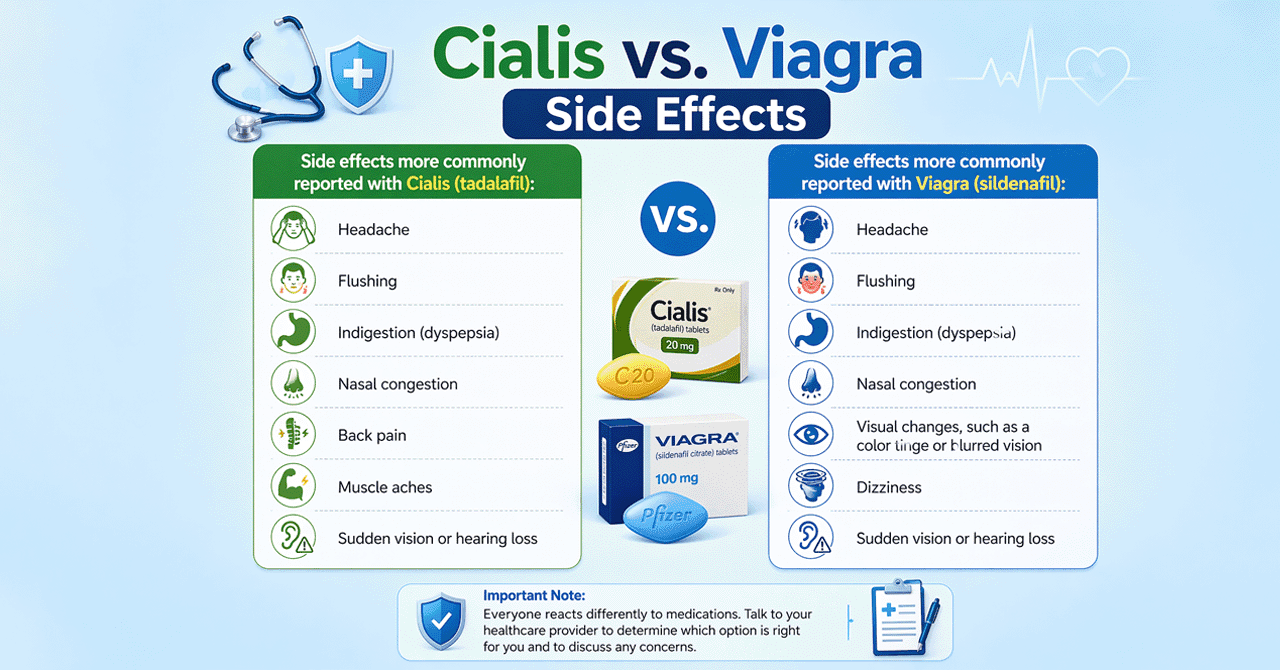
Both medications have similar side effects because they belong to the same drug class, but some differences can influence how they are tolerated.
Common side effects of Cialis and Viagra:
- Headache
- Flushing
- Indigestion (dyspepsia)
- Nasal congestion
Side effects more commonly reported with Viagra (sildenafil):
- Visual changes, such as a color tinge or blurred vision
- Dizziness
Side effects more commonly reported with Cialis (tadalafil):
- Back pain
- Muscle aches
Serious but rare side effects of Cialis and Viagra:
- Sudden vision or hearing loss
- Prolonged erection persisting more than 4 hours (priapism), which requires immediate medical attention
Cialis vs. Viagra for BPH and Additional Uses
One key difference between these medications is that Cialis is approved for more than erectile dysfunction.
- FDA prescribing information states that Cialis is indicated for erectile dysfunction and the signs and symptoms of benign prostatic hyperplasia (BPH)
- It may help improve urinary symptoms such as difficulty starting urination, weak urine flow, and incomplete bladder emptying.
- Viagra is approved only for erectile dysfunction and is not used to treat BPH.
If you have both erectile dysfunction and BPH, Cialis can address both conditions with a single treatment.
Who Should Avoid Cialis or Viagra
These medications are not safe for everyone and may cause serious risks in certain conditions or when combined with specific drugs.
| Risk Factor | Why It Matters |
|---|---|
| Use of nitrates (for chest pain) | Can cause a dangerous drop in blood pressure when combined with PDE5 inhibitors |
| Cardiovascular conditions | Sexual activity may be inadvisable in patients with certain cardiovascular conditions |
| Recent heart attack or stroke | May increase the risk of complications during treatment |
| Low blood pressure | These medications can further lower blood pressure |
| Certain drug interactions | Use of interacting medications such as nitrates, alpha blockers, or antihypertensives |
← Swipe to see more →
You should speak with a healthcare provider before starting Cialis or Viagra to determine if these medications are safe based on your medical history and current medications.
The Bottom Line: Choosing Between Cialis and Viagra
Cialis and Viagra are both effective treatments for erectile dysfunction (ED), but they differ in how long they last, how quickly they work, and how they fit into your routine. Cialis provides a longer duration of effect and can be taken daily or as needed, while Viagra works faster and is typically used before planned sexual activity.
Cialis also has an additional use for benign prostatic hyperplasia, which Viagra does not. The right option depends on your health condition, lifestyle, and how you prefer to use the medication, so a healthcare provider can help determine the most suitable choice.
Frequently Asked Questions
No. Taking both together can increase the risk of side effects such as low blood pressure and is not recommended.
Yes. Cialis has been shown to improve erectile function for up to 36 hours after a dose, while Viagra typically works for about 4 to 6 hours.
Viagra may start working within 30 minutes and is typically taken about 1 hour before sexual activity, while Cialis is usually taken at least 30 minutes before and may take longer to reach full effect.
No. These medications cannot be directly compared by dose because they contain different active ingredients and work differently in the body.
Food, especially high-fat meals, may delay how quickly Viagra works. Cialis is not significantly affected by food.
Important Disclaimer
This blog is provided for informational purposes only and does not replace expert medical guidance, diagnosis, or treatment. The information is based on trusted sources such as the U.S. Food and Drug Administration (FDA), National Library of Medicine (NLM), and other reputable medical references, but individual responses to medications may vary. Always consult an authorized healthcare professional before making treatment decisions.