Health Insurance for Self-Employed GLP-1 Coverage: 2026 Cost Strategy Guide
Key Takeaways
1. Self-employed GLP-1 coverage in 2026 depends on the plan, diagnosis, formulary, deductible, and prior authorization rules.
2. Freelancers, gig workers, and small business owners should compare total yearly costs, not just monthly premiums.
3. ACA Marketplace plans may help, but patients should check exact GLP-1 drug coverage before enrolling.
4. HSA and HDHP strategies may support cost planning, but they do not make excluded drugs covered.
5. Tax deductions, solo 401(k) planning, and business structure can affect cash flow, not direct drug coverage.
6. Before paying cash, patients should review appeals, manufacturer programs, patient assistance programs, and pharmacy options.
Health insurance for self-employed GLP-1 coverage can feel confusing in 2026. Freelancers, gig workers, and small business owners often compare plans without employer support. Costs may depend on ACA Marketplace plans, formularies, deductibles, prior authorization, tax deductions, HSA rules, and cash-pay options. This guide explains a self-employed prescription drug coverage strategy for US patients.
What Is Health Insurance for Self-Employed GLP-1 Coverage in 2026?
Health insurance for self-employed GLP-1 coverage means choosing an individual plan. That plan may help with GLP-1 receptor agonists, depending on its drug rules. For semaglutide insurance options self-employed patients should check the formulary, diagnosis, prior authorization, deductible, and pharmacy rules. Ozempic coverage for self-employed patients may also depend on the plan’s approved-use criteria.
A formulary is the plan’s list of covered prescription drugs. Marketplace plans may help pay for formulary drugs. Costs can still vary by tier, network, deductible, copay, or coinsurance. Patients should check the exact drug name before enrolling. Ozempic, Wegovy, Mounjaro, and Zepbound may be reviewed differently.
The simple reason is that GLP-1 drugs can have different FDA-approved uses. Some are approved for type 2 diabetes. Others are obesity management drugs approved for chronic weight management. A plan may cover one GLP-1 for one diagnosis. It may require extra documentation when the request involves medically necessary weight loss.

Why Self-Employed Workers May Struggle With GLP-1 Coverage
Self-employed workers often choose and manage their own health insurance. Freelancers, gig workers, and solo business owners may use the individual Marketplace. Each plan can have different drug rules, deductibles, and approval requirements.
This makes GLP-1 cost planning harder than checking one monthly premium. A lower-premium plan may still cost more overall. This can happen if the drug is not listed or needs approval. HealthCare.gov explains that a formulary is the list of prescription drugs covered by a plan, so patients should check the exact GLP-1 name before enrollment.
Income can also make planning harder. Marketplace savings are based on estimated income for the coverage year. That can be tricky for 1099 contractors, rideshare drivers, delivery workers, creators, and small business owners. If income changes, patients may need to update their Marketplace application.
Research from PubMed Central on GLP-1 obesity medications highlights concerns about high prices, uneven coverage, and out-of-pocket costs. For self-employed patients, the real question is whether insurance, appeals, tax planning, manufacturer support, or cash-pay makes better financial sense.
How ACA Marketplace Health Insurance Affects Self-Employed GLP-1 Coverage
Affordable Care Act (ACA) Marketplace plans can be a starting point for self-employed GLP-1 coverage. People without employer coverage can compare individual plans through the Marketplace.
Marketplace plans are usually grouped into metal categories, such as Bronze, Silver, Gold, and Platinum. These categories do not show care quality. They show how the patient and plan may share costs. A lower-premium plan may have higher out-of-pocket costs when care is needed.
For GLP-1 medications, the most important details are often inside the prescription drug benefit. Patients should review the formulary, drug tier, deductible, copay, coinsurance, and pharmacy network. They should also watch for formulary coverage changes 2026. A plan may cover general medical care but still handle GLP-1 drugs differently.
Self-employed patients should also estimate their yearly income carefully. Marketplace savings are based on expected income for the coverage year. This can be tricky for people with changing income, such as rideshare drivers, delivery workers, consultants, and online creators.
How to Choose a Marketplace Plan for GLP-1 Coverage
Before enrolling, self-employed patients should check these drug coverage details.
| What to Check | Why It Matters |
|---|---|
| Exact GLP-1 drug name | Ozempic, Wegovy, Mounjaro, and Zepbound may have different coverage rules. Mounjaro cost self-employed 2026 searches should start with exact plan rules. |
| Formulary status | Shows whether the plan lists the drug |
| Drug tier | Can affect copay or coinsurance |
| Prior authorization | The plan may require approval before payment |
| Step therapy | The plan may require another treatment first |
| Deductible | The patient may pay the full cost before coverage starts |
| Pharmacy network | Costs may change by pharmacy |
| Out-of-pocket maximum | Helps estimate yearly covered medical costs |
← Swipe to see more →
HSA and HDHP Strategy for Self-Employed GLP-1 Costs
An HSA and HDHP strategy may help some self-employed patients manage GLP-1 costs. An HSA, or Health Savings Account, allows eligible people to set aside money for qualified medical expenses. It must generally be paired with an HSA-eligible high-deductible health plan.
For 2026, IRS guidance lists HSA contribution limits and HDHP requirements. These rules matter because not every health plan allows HSA contributions. Patients should confirm whether the Marketplace plan is HSA-eligible before assuming they can use this strategy.
This matters for patients using ongoing medications. A PubMed Central study reviewed high-deductible plan switches among diabetes patients. It linked forced switches with higher risks of severe hypoglycemia and hyperglycemia. The study is not GLP-1 specific. Still, it shows why patients should review deductible exposure carefully.
For GLP-1 medication, the key question is whether the drug is covered and how the deductible applies. An HSA can help with eligible expenses, but it cannot make an excluded drug covered.
Self-Employed GLP-1 Coverage and Tax Deductions
Self-employed GLP-1 coverage planning should also include tax deductions. Eligible taxpayers may deduct some health insurance premiums using Form 7206. The deduction is reported on Schedule 1 of Form 1040.
This deduction generally relates to health insurance premiums. It does not automatically make the full GLP-1 cost deductible. Prescription drug costs may fall under medical expense rules, but tax treatment depends on the patient’s full situation.
However, patients should not treat tax savings as guaranteed. The deduction can depend on business income, eligibility, other coverage, and how the return is filed. A tax professional can compare premium tax credits, deductions, HSA rules, and medical expense rules.
Solo 401(k), HSA, and GLP-1 Cost Planning for Self-Employed Workers
Self-employed workers may also need to balance GLP-1 costs with retirement planning. A solo 401(k), also called a one-participant 401(k), is a retirement plan option for business owners with no employees other than a spouse.
A solo 401(k) does not decide whether Ozempic, Wegovy, Mounjaro, or Zepbound is covered. Coverage still depends on the health plan, formulary, diagnosis, prior authorization, and pharmacy benefit.
Retirement contributions, HSA contributions, premiums, and prescriptions all affect cash flow. Patients should review solo 401(k), HSA, and health insurance planning with a tax professional or financial advisor.
LLC vs. Sole Proprietor: Does Business Structure Affect GLP-1 Coverage?
An LLC or sole proprietor setup may affect tax filing, business liability, and how income is reported. It does not automatically decide whether a GLP-1 medication is covered. The health plan’s formulary and prescription rules still control medication coverage.
The main point is simple: business structure may affect tax planning, but it does not replace plan research. Patients still need to check the exact GLP-1 drug, diagnosis rules, prior authorization requirements, deductible, and pharmacy network.
Self-employed patients should review both sides together: business structure with a tax professional, and GLP-1 coverage with the insurer or Marketplace plan.
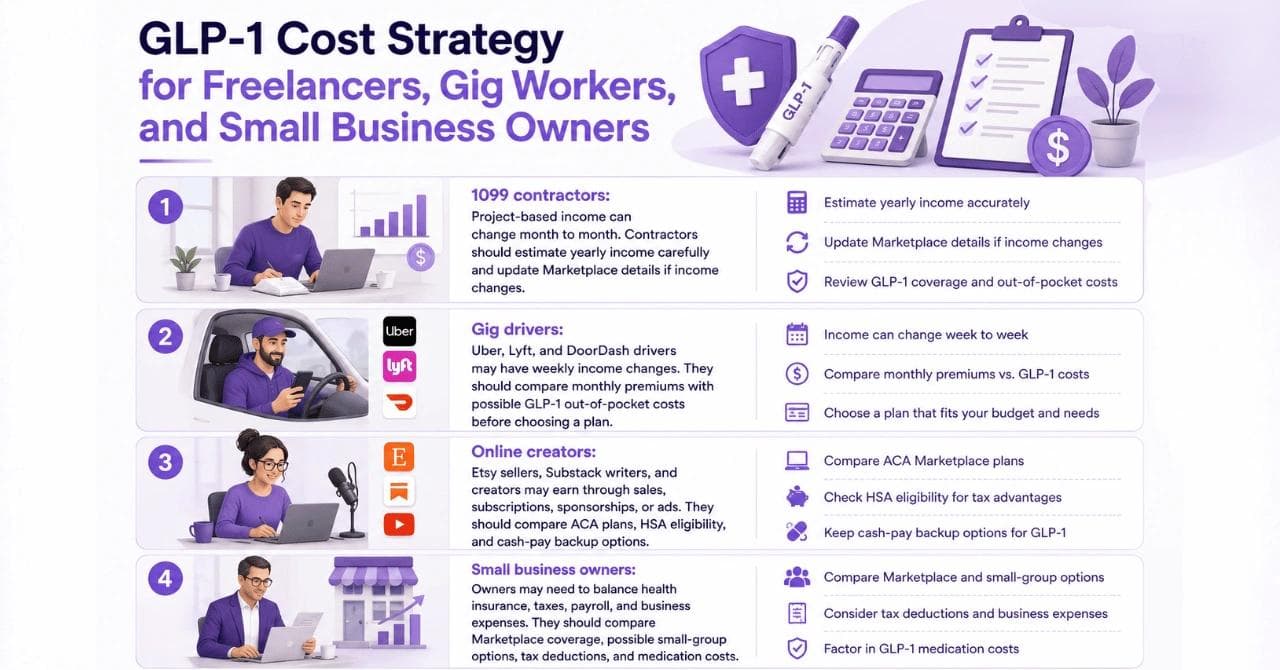
GLP-1 Cost Strategy for Freelancers, Gig Workers, and Small Business Owners
Different self-employed workers need different GLP-1 cost strategies. The best starting point is to compare total annual cost, including premiums, deductibles, copays, coinsurance, prescription rules, and possible uncovered medication costs.
- 1099 contractors: Project-based income can change month to month. Contractors should estimate yearly income carefully and update Marketplace details if income changes.
- Gig drivers: Uber, Lyft, and DoorDash drivers may have weekly income changes. They should compare monthly premiums with possible GLP-1 out-of-pocket costs before choosing a plan.
- Online creators: Etsy sellers, Substack writers, and creators may earn through sales, subscriptions, sponsorships, or ads. They should compare ACA plans, HSA eligibility, and cash-pay backup options.
- Small business owners: Owners may need to balance health insurance, taxes, payroll, and business expenses. They should compare Marketplace coverage, possible small-group options, tax deductions, and medication costs.
When Self-Employed Patients May Skip Insurance for GLP-1 and Pay Cash
Some self-employed patients may consider cash-pay when insurance does not cover a GLP-1 medication. This can happen when the drug is excluded, prior authorization is denied, step therapy applies, or the deductible makes the first month expensive. Cash-pay is not automatically better. Health insurance may still protect against hospital care, emergency treatment, labs, and other covered costs.
Legitimate Options Before Paying Full Cash Price for GLP-1 Medication
Before paying the full cash price, self-employed patients should review every legitimate option. This may include ACA Marketplace plans, internal appeals, external review, formulary exceptions, manufacturer savings, patient assistance programs (PAPs), state assistance, advocacy resources, and pharmacy price comparison. If coverage is denied, patients should check the appeal deadline listed in the denial notice.
Canadian Pharmacy Option for Self-Employed GLP-1 Coverage Gaps
A Canadian pharmacy may be one option for self-employed patients comparing cash-pay routes. Polar Bear Meds is one Canadian pharmacy option patients may compare while reviewing GLP-1 cash-pay choices. Patients should still use a valid prescription, check pharmacy safety, and review official FDA and Health Canada guidance before buying prescription medication online.
Self-Employed GLP-1 Cost Strategy Comparison Table
Self-employed patients should compare total yearly costs before choosing a GLP-1 payment strategy. The table below shows common options to review before making a coverage or payment decision.
| GLP-1 Cost Strategy | Best For | What to Check First | Possible Limitation |
|---|---|---|---|
| ACA Marketplace Plan | Self-employed patients needing full health coverage | Formulary, drug tier, deductible, copay, coinsurance, pharmacy network, and prior authorization | GLP-1 medication may still require approval or may not be covered for every diagnosis |
| HDHP + HSA Strategy | Patients who qualify for an HSA and want tax-advantaged savings | IRS HDHP eligibility, deductible, out-of-pocket limit, and HSA contribution limit | Higher upfront costs before the deductible is met |
| Manufacturer Savings or Assistance Program | Eligible patients using brand-name GLP-1 medications | Program terms, insurance status, income rules, and drug eligibility | Not every patient or medication qualifies |
| Prior Authorization or Formulary Exception | Patients whose plan denies or restricts coverage | Medical necessity documents, diagnosis, previous treatments, and appeal deadline | Approval is not guaranteed |
| Self-Employed Health Insurance Deduction | Eligible self-employed taxpayers paying their own premiums | IRS Form 7206, Schedule 1, business income, and tax eligibility | This may reduce taxable income, but it does not directly lower pharmacy prices |
| Canadian Pharmacy Cash-Pay Option | Patients comparing non-insurance cash-pay routes | Valid prescription, pharmacy licensing, drug source, and FDA/Health Canada safety guidance | It is not a substitute for full health insurance |
| Full Cash-Pay in the US | Patients skipping insurance for the medication | Monthly drug price, pharmacy price, prescription requirements, and refill cost | No plan protection against high medical costs |
← Swipe to see more →
Bottom Line: Best Health Insurance Strategy for Self-Employed GLP-1 Coverage
The best health insurance strategy for self-employed GLP-1 coverage depends on income, diagnosis, plan rules, taxes, and medication costs. Patients should compare ACA plans, HSA eligibility, deductions, manufacturer programs, appeals, and cash-pay options. The goal is not just the lowest premium. It is a safe, realistic self-employed prescription drug coverage strategy for the year.
Frequently Asked Questions
The best health insurance for self-employed GLP-1 coverage depends on the patient’s income, diagnosis, prescription, and plan rules. A good plan should be reviewed for formulary status, prior authorization, deductible, copay, coinsurance, and pharmacy network before enrollment.
Some health plans may cover GLP-1 medication for weight loss, but coverage is plan-specific. Patients should check whether the exact drug is listed on the formulary and whether the plan covers it for their diagnosis. Prior authorization or step therapy may also apply.
Semaglutide insurance options for self-employed patients may include ACA Marketplace plans, prior authorization, formulary exceptions, manufacturer savings, and cash-pay comparison. Patients should check whether Ozempic or Wegovy is listed under the plan’s prescription drug benefit.
Some self-employed patients may qualify for lower-cost Marketplace coverage through premium tax credits, depending on income and household details. However, lower premiums do not guarantee GLP-1 coverage. Patients still need to check the drug list, deductible, and approval rules.
Patients can check GLP-1 coverage by reviewing the plan formulary, drug tier, prior authorization rules, step therapy rules, deductible, copay, coinsurance, and pharmacy network. They should search the exact drug name, such as Ozempic, Wegovy, Mounjaro, or Zepbound.
ACA Marketplace plans may include prescription drug benefits, but GLP-1 coverage can vary by plan, medication, and diagnosis. A plan may cover one GLP-1 drug differently from another. Self-employed patients should confirm coverage directly before enrolling.
Self-employed workers may find lower-premium Marketplace plans, but “cheap” insurance is not always cheaper overall. A low monthly premium may come with a high deductible, high coinsurance, or limited drug coverage. The total yearly cost is more important than the premium alone.
Disclaimer
This blog is for general information and cost-comparison purposes only. It is not medical, legal, insurance, tax, financial, or pharmacy advice. GLP-1 coverage rules, formularies, prior authorization requirements, appeal deadlines, savings programs, prices, and prescription requirements can change. Details may vary by plan, carrier, pharmacy, location, diagnosis, medication, and patient eligibility. Always confirm information with your insurer, Marketplace plan, prescriber, pharmacist, tax professional, or official program source before making coverage, appeal, tax, or purchase decisions.