Lost GLP-1 insurance coverage in 2026? The Complete Recovery Guide for US Patients
Key Takeaways
1. Lost GLP-1 insurance coverage in 2026 can happen because of plan changes, denials, exclusions, or documentation gaps.
2. Patients should first check their denial letter, formulary, plan document, and appeal deadline.
3. Major carriers may handle GLP-1 coverage differently by plan, employer, diagnosis, and region.
4. Appeals, COBRA, ACA Marketplace plans, and manufacturer savings programs can help some patients.
5. Cash-pay options, including licensed Canadian pharmacy comparison, should be reviewed carefully.
6. Patients should confirm prescription rules, pharmacy licensing, shipping terms, and total costs before paying.
When insurance coverage changes, GLP-1 costs can become difficult to manage. Lost GLP-1 insurance coverage in 2026 may involve denials, plan changes, BMI rules, or step therapy. Some patients also lose access after layoffs or COBRA changes. This lost GLP-1 coverage 2026 guide helps US patients review appeals, Marketplace plans, savings programs, and legitimate cash-pay Canadian pharmacy options.
Why US Patients Are Losing GLP-1 Insurance Coverage in 2026
US patients are losing GLP-1 insurance coverage in 2026 for several reasons. Most changes come from benefit design redesign, plan exclusions, prior authorization rules, and cost pressure. Coverage also depends on the diagnosis, drug name, and plan document.
Many employer health plans review GLP-1 coverage during each plan year. Some plans cover GLP-1 drugs for type 2 diabetes. They may still exclude drugs used only for weight management. This creates confusion for patients using Wegovy, Zepbound, Ozempic, or Mounjaro.
Cost pressure is another major reason. GLP-1 drugs can create high pharmacy spending for employer plans. Some employers respond by adding stricter prior authorization rules. Others limit coverage to certain diagnoses or remove weight-loss coverage.
Patients can also lose access after renewal reviews. A plan may ask for updated BMI records, diagnosis codes, or treatment documentation. If the paperwork does not match the policy, coverage may stop.
Coverage loss can affect patients beyond monthly costs. A 2026 PubMed Central study found that discontinued GLP-1 obesity coverage affected employee satisfaction and burnout. It also raised concerns about workplace retention among some employees. The safest first step is verification. Plan records can show whether coverage changed because of documentation, renewal rules, or formal exclusions.
Common Reasons GLP-1 Insurance Coverage Gets Denied or Removed
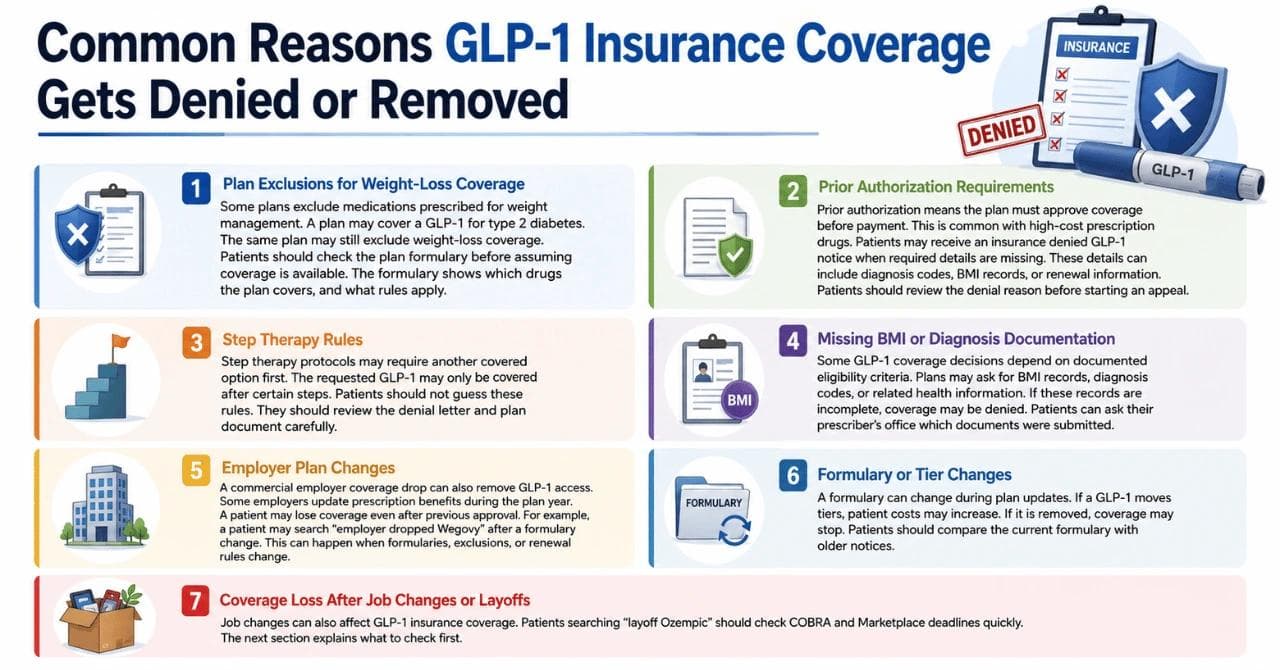
GLP-1 insurance coverage can be denied or removed for several plan-based reasons. Most issues come from prior authorization rules, plan exclusions, step therapy, or missing documents. Patients should always check their denial letter before assuming coverage is gone permanently.
Plan Exclusions for Weight-Loss Coverage
Some plans exclude medications prescribed for weight management. A plan may cover a GLP-1 for type 2 diabetes. The same plan may still exclude weight-loss coverage. Patients should check the plan formulary before assuming coverage is available. The formulary shows which drugs the plan covers, and what rules apply.
Prior Authorization Requirements
Prior authorization means the plan must approve coverage before payment. This is common with high-cost prescription drugs. Patients may receive an insurance denied GLP-1 notice when required details are missing. These details can include diagnosis codes, BMI records, or renewal information. Patients should review the denial reason before starting an appeal.
Step Therapy Rules
Step therapy protocols may require another covered option first. The requested GLP-1 may only be covered after certain steps. Patients should not guess these rules. They should review the denial letter and plan document carefully.
Missing BMI or Diagnosis Documentation
Some GLP-1 coverage decisions depend on documented eligibility criteria. Plans may ask for BMI records, diagnosis codes, or related health information. If these records are incomplete, coverage may be denied. Patients can ask their prescriber’s office which documents were submitted.
Employer Plan Changes
A commercial employer coverage drop can also remove GLP-1 access. Some employers update prescription benefits during the plan year. A patient may lose coverage even after previous approval. For example, a patient may search “employer dropped Wegovy” after a formulary change. This can happen when formularies, exclusions, or renewal rules change.
Formulary or Tier Changes
A formulary can change during plan updates. If a GLP-1 moves tiers, patient costs may increase. If it is removed, coverage may stop. Patients should compare the current formulary with older notices.
Coverage Loss After Job Changes or Layoffs
Job changes can also affect GLP-1 insurance coverage. Patients searching “layoff Ozempic” should check COBRA and Marketplace deadlines quickly. The next section explains what to check first.
What to Check First After Losing GLP-1 Insurance Coverage
After losing GLP-1 insurance coverage, verify the exact reason first. A denial letter or benefits notice usually explains what changed. It may show an exclusion, missing document, renewal issue, or prior authorization problem.
Check these items before choosing a backup path:
- Denial letter: Review the reason code, appeal deadline, and requested documents.
- Current formulary: Confirm whether your GLP-1 is covered, excluded, or placed on another tier.
- Prior authorization rules: Check whether approval, renewal records, or updated documents are required.
- Summary Plan Description: Review exclusions, benefit limits, and appeal rights.
- Benefits notice: Check whether the change came from your employer or insurance plan.
- Appeal process: Ask for the deadline, required forms, fax number, and records needed.
- Prescriber documents: Confirm which diagnosis details or medical records were submitted.
- Out-of-pocket tracking: Compare premiums, deductibles, copays, and cash-pay prices together.
This first check can prevent rushed decisions. It also helps patients understand whether coverage ended permanently or needs updated documentation.
How Major Insurance Carriers Handle GLP-1 Coverage in 2026
Major insurance carriers do not handle GLP-1 coverage the same way for every patient. Coverage depends on the plan type, employer benefit design, diagnosis, formulary, and prior authorization rules.
Patients should also separate diabetes coverage from weight-loss coverage. Searches like “BCBS Aetna Cigna dropped GLP-1” need plan-level verification. A plan may cover one GLP-1 for type 2 diabetes. The same plan may still restrict or exclude GLP-1 drugs for weight management.
Blue Cross Blue Shield GLP-1 Coverage
Blue Cross Blue Shield coverage varies by local BCBS company and plan type. Patients should check their current formulary, prior approval rules, and quantity limits.
For federal employees, FEP Blue lists prior approval and quantity limit rules for some drugs. It also notes that some drugs require approval before coverage applies. Patients should review their plan document before assuming coverage applies.
BCBS has also discussed GLP-1 cost pressure for employer health plans. Its analysis says broader GLP-1 coverage can affect employer premiums. Patients should still verify their own plan, not general BCBS articles.
Aetna GLP-1 Coverage
Aetna members should check the plan formulary and pharmacy benefit portal first. Coverage can vary between employer plans, ACA plans, Medicare plans, and Medicaid plans.
Patients should look for three things. Check whether the drug is listed, whether prior authorization applies, and whether weight-loss use is excluded. The employer’s benefit design may decide what the plan covers.
If coverage is denied, patients should request the denial reason in writing. They should also ask whether an appeal, exception, or updated prior authorization is available.
Cigna GLP-1 Coverage
Cigna coverage also depends on the exact plan document. Patients should review the formulary, coverage policy, prior authorization rules, and benefit exclusions.
In June 2026, Reuters reported that Cigna would stop covering GLP-1 weight-loss drugs for its own employee plan. That report also said the change did not apply to all Cigna-administered plans. This is why patients should verify their own plan first.
A Cigna-administered employer plan may follow different rules than another employer plan. Patients should avoid assuming one Cigna decision applies everywhere.
UnitedHealthcare GLP-1 Coverage
UnitedHealthcare members should check the Prescription Drug List and prior authorization rules. UHC explains that a Prescription Drug List is also called a formulary. It organizes covered medications into cost levels called tiers.
UnitedHealthcare’s 2026 commercial prior authorization document includes weight-loss medication criteria. It also lists authorization periods for Wegovy and Zepbound in certain cases. Patients should review the exact plan policy before relying on coverage.
Patients should also check renewal rules. A medication may require updated approval after the first authorization period ends.
Kaiser Permanente GLP-1 Coverage
Kaiser Permanente coverage can vary by region, plan type, and formulary. Patients should check the formulary for their state, region, and coverage category.
A formulary lists drugs covered by a health plan. It may also show prior authorization, step therapy, or exception rules. Patients should review the most current Kaiser formulary before assuming GLP-1 coverage applies.
If a drug is not listed, patients can ask about exception options. They should also confirm whether the denial involves the drug, diagnosis, documents, or benefit design.
What Patients Should Do Across All Carriers
Patients should not rely on the carrier name alone. The same carrier may manage many different plans.
Before calling the plan, gather these details:
- Drug name and dosage form
- Diagnosis category
- Current formulary status
- Prior authorization status
- Appeal deadline
- Employer plan document
- Pharmacy benefit manager details
How to Appeal a GLP-1 Insurance Denial in 2026
A GLP-1 insurance denial is not always final. Some patients may also ask about a continuity of care exception. The denial letter usually explains the next step.
Start by checking the appeal deadline. Then confirm which documents the plan needs. These may include diagnosis details, BMI records, treatment history, or a Letter of medical necessity.
Patients should also ask whether the issue involves missing records, step therapy, or a plan exclusion. Missing records may be fixable. A plan exclusion may be harder to overturn.
The prescriber’s office may need to submit supporting documents. Patients should keep copies of every denial letter, appeal form, and plan response.
Before paying cash, wait to see whether the appeal can recover GLP-1 coverage. This can prevent unnecessary out-of-pocket spending.
COBRA vs ACA Marketplace After Losing GLP-1 Insurance Coverage
After losing employer coverage, many US patients compare COBRA and ACA Marketplace plans first. Both options can help restore insurance access, but they work differently. COBRA may keep the same plan temporarily. Marketplace plans may offer new coverage choices. Patients should compare premiums, formularies, prior authorization rules, and GLP-1 exclusions before choosing.
| Option | What It Means | What to Check for GLP-1 Coverage |
|---|---|---|
| COBRA | Keeps the same employer plan temporarily | Monthly premium, drug formulary, PA rules, deductible |
| ACA Marketplace | Lets eligible patients choose a new plan | GLP-1 formulary status, exclusions, tier, PA rules |
| Spouse or partner plan | May offer faster employer-based coverage | Enrollment window, drug coverage, employer exclusions |
| Medicaid | May help eligible low-income patients | State rules, weight-loss drug limits, PA requirements |
← Swipe to see more →
Manufacturer Savings Programs After Losing GLP-1 Insurance Coverage
Manufacturer savings programs may help some patients after GLP-1 coverage loss. These programs can include savings cards, direct-pay options, or patient assistance programs.
Patients should check official terms before relying on any retail cash price. Eligibility can depend on insurance type, diagnosis, income, and program limits. Some offers may exclude government insurance beneficiaries.
NovoCare lists Wegovy savings and pharmacy options on its official patient-support site. Lilly also lists Zepbound savings terms, eligibility rules, and program limits. These terms can change, so patients should verify them directly before paying.
Manufacturer programs should be compared with appeals, COBRA, Marketplace plans, and pharmacy cash prices. They may lower costs for eligible patients, but they do not replace insurance coverage.

Cash-Pay GLP-1 Options When Insurance Coverage Is Gone
When insurance coverage is gone, patients may need to compare cash-pay options. Research on affordable GLP-1 access notes that high prices and limited coverage can affect medication access. Patients should still verify each option before paying.
Common cash-pay paths include manufacturer direct-pay programs, local pharmacy prices, and discount card prices. Some patients also compare licensed Canadian pharmacy options. Each path can have different pricing, prescription rules, shipping timelines, and availability.
Polar Bear Meds is one Canadian pharmacy option US patients may compare. It should be reviewed alongside appeals, Marketplace plans, manufacturer programs, and local cash prices. Patients should not choose based on price alone. The next section explains how to compare pharmacy options safely.
How to Compare GLP-1 Cash Prices Safely After Losing Coverage
After losing coverage, patients may compare GLP-1 cash prices across several sources. Price matters, but safety should come first. A very low price can be a warning sign, not a bargain.
Patients should confirm that the pharmacy requires a valid prescription. They should also check licensing, pharmacist access, contact details, and shipping policies. Health Canada says legitimate online pharmacies should require a valid prescription. It also says they should be licensed by a provincial or territorial pharmacy authority.
The FDA also warns that unsafe online pharmacies may sell counterfeit or unsafe medicines. Some may offer deep discounts without requiring a prescription. Patients should avoid websites that hide their address, licensing, or pharmacist information.
Before paying cash, compare the full cost. Include the drug price, shipping fees, refill timing, prescription requirements, and delivery conditions. This helps patients compare pharmacy options more safely after insurance coverage ends.
Final Thoughts on Losing GLP-1 Insurance Coverage in 2026
Losing GLP-1 insurance coverage in 2026 can feel stressful and expensive. Still, patients should verify the reason before choosing a backup path. Start with official plan records, then compare insurance and cash-pay options carefully. Then compare COBRA, Marketplace plans, manufacturer programs, and safe cash-pay options.
Some US patients also compare licensed Canadian pharmacy pricing when insurance remains unavailable. The best next step depends on the patient’s plan, diagnosis, budget, and prescription needs. Always confirm details with the insurer, prescriber, pharmacy, or official program source first.
Frequently Asked Questions
Your prescription may still be valid, but payment rules can change. Ask your prescriber and pharmacy whether the prescription, refill timing, and pharmacy route still meet current requirements.
Cash payments may not count toward insurance deductibles or out-of-pocket limits. Patients should confirm this with their insurance plan before paying outside their benefit.
A prescriber may review covered alternatives if your plan excludes one brand. Patients should discuss any medication change with their prescriber first.
Yes. Save receipts, pharmacy invoices, denial letters, and appeal responses. These records can help with reimbursement requests, tax documentation, or future coverage reviews.
Disclaimer
This blog is for general information and cost-comparison purposes only. It is not medical, legal, insurance, financial, or pharmacy advice. GLP-1 coverage rules, formularies, prior authorization requirements, appeal deadlines, savings programs, prices, and prescription requirements can change. They may vary by plan, employer, carrier, pharmacy, location, diagnosis, and medication. Always confirm details with your insurer, benefits administrator, prescriber, pharmacy, or official program source before making coverage, appeal, or purchase decisions.