Medicare Bridge $50/Month vs. Polar Bear Meds Direct: The Honest 2026 Cost Comparison
Key Takeaways
- The Medicare GLP-1 Bridge launches July 1, 2026, offering covered GLP-1s for $50/month through December 2027.
- Eligibility requires Medicare Part D enrollment, specific BMI and health criteria, and prior authorization.
- Polar Bear Meds connects U.S. patients to licensed Canadian pharmacies, with potential savings up to 90% vs. U.S. retail prices.
- Neither option works for everyone; the right choice depends on your eligibility, medications, and total drug costs.
The Medicare Bridge 50-month program changes the math for many Medicare patients starting July 1, 2026. For the first time, eligible beneficiaries can access specific GLP-1 weight-loss medications at a fixed $50 monthly copay. But not everyone qualifies, and not every medication is covered. Here's what each option actually costs, who each one serves, and how to decide which makes sense for your situation.
Medicare GLP-1 Bridge Launches July 2026: What $50/Month Actually Covers
The Medicare GLP-1 Bridge is a temporary demonstration program, not a permanent benefit. It runs from July 1, 2026, through December 31, 2027, giving eligible Medicare beneficiaries access to certain GLP-1 medications at a flat $50 monthly copay, according to Medicare.gov.
Eligibility isn't automatic. Beneficiaries must be at least 18, carry Medicare Part D drug coverage, meet specific BMI and health criteria, and receive prior authorization before the program pays out. That prior authorization step trips up some applicants, so starting the paperwork early matters.
The covered medications are specific: Foundayo, Wegovy (both injection and tablet forms), and Zepbound (KwikPen only), all when prescribed for weight management. One detail that catches people off guard: the $50 copay does NOT count toward your Medicare drug plan deductible or your yearly out-of-pocket maximum. That separation means the Bridge operates as its own cost island, which is good when you're paying $50 for a drug that costs hundreds elsewhere, but worth understanding before you assume it reduces your broader Part D exposure.
Polar Bear Meds Direct: How Canadian Pharmacy Intermediaries Work
Polar Bear Meds operates as a licensed intermediary, connecting U.S. customers to verified, licensed Canadian pharmacies and international fulfillment centers. You're not buying from a gray-market storefront. The model involves a real licensed pharmacy on the other end, a valid prescription requirement on your end, and a shipping process that brings the medication to your U.S. address.
Pricing varies by medication rather than a flat subscription fee. For GLP-1s specifically, Wegovy runs approximately $599 per pen, and a four-week supply of Zepbound single-dose vials comes in around $499. Those figures include the drug price, but the total at checkout also reflects shipping and any applicable fees. Polar Bear Meds claims savings of up to 90% compared to U.S. retail prices, which is a meaningful gap when brand-name GLP-1s at U.S. pharmacies routinely cost over $1,000 per month without insurance.
Customer feedback is strong. As of June 2026, the service holds a 4.9 out of 5-star rating from 524 verified reviews on Shopper Approved. You can read through customer reviews from U.S. patients directly on their site. A valid, doctor-issued prescription is required for every order, no exceptions.

Is It Legal and Safe? FDA Rules and Pharmacy Verification
The FDA generally allows personal importation of prescription medications from Canada for personal use, typically up to a 90-day supply, provided you have a valid U.S. prescription, and the drugs are approved for use in the U.S. That policy creates a legal pathway for patients, though the FDA doesn't provide regulatory oversight of medicines sourced outside the standard U.S. drug supply chain.
Licensed Canadian pharmacies are a different category from rogue online operations. Look for pharmacies that require prescriptions, operate transparently, and source medications that have been rigorously tested by Health Canada.
The real risks sit with unverified sites. Rogue online pharmacies sometimes sell counterfeit, contaminated, or substandard products, and some don't require a prescription at all. That last point is your clearest red flag. Any pharmacy willing to dispense without a valid prescription is not a pharmacy worth trusting. Before ordering medication online, verify licensing, confirm a prescription requirement, and check for transparent contact information and a physical address.
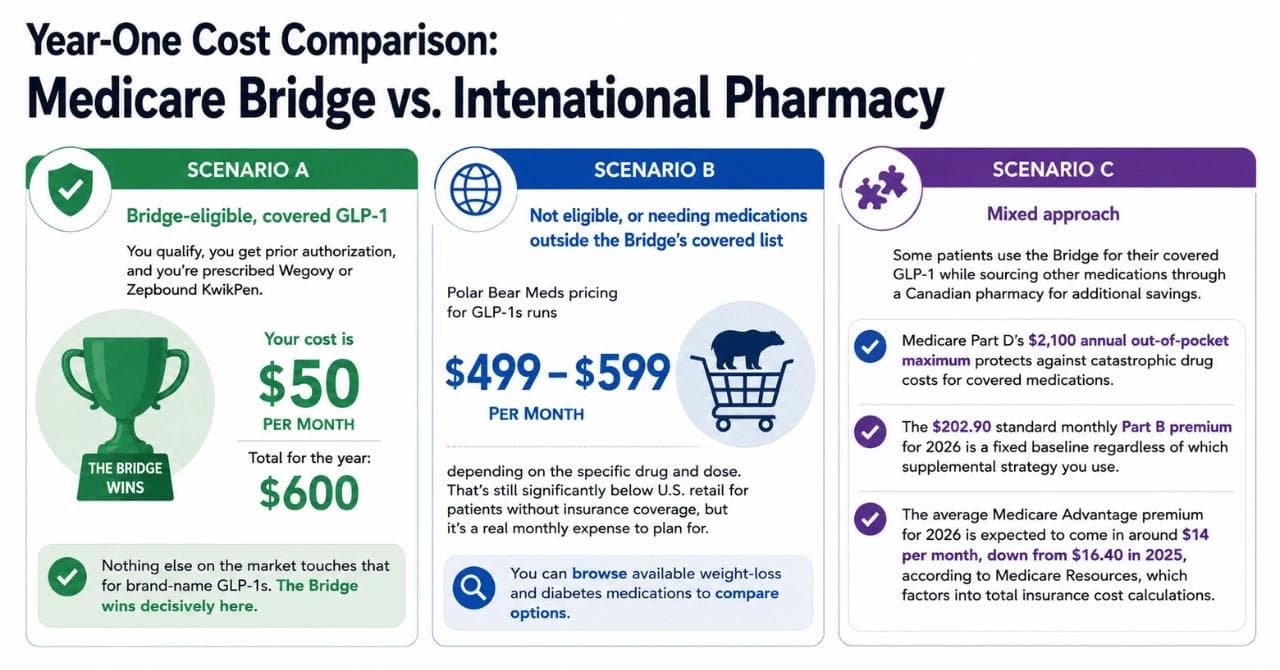
Year-One Cost Comparison: Medicare Bridge vs. International Pharmacy
Here's where the numbers get concrete. Three scenarios cover most patients.
Scenario A (Bridge-eligible, covered GLP-1): You qualify, you get prior authorization, and you're prescribed Wegovy or Zepbound KwikPen. Your cost is $50 per month, totaling $600 for the year. Nothing else on the market touches that for brand-name GLP-1s. The Bridge wins decisively here.
Scenario B (Not eligible, or needing medications outside the Bridge's covered list): Polar Bear Meds pricing for GLP-1s runs $499 to $599 per month, depending on the specific drug and dose. That's still significantly below U.S. retail for patients without insurance coverage, but it's a real monthly expense to plan for. You can browse available weight-loss and diabetes medications to compare options.
Scenario C (Mixed approach): Some patients use the Bridge for their covered GLP-1 while sourcing other medications through a Canadian pharmacy for additional savings. This hybrid approach makes practical sense. Medicare Part D's $2,100 annual out-of-pocket maximum protects against catastrophic drug costs for covered medications, and the $202.90 standard monthly Part B premium for 2026 is a fixed baseline regardless of which supplemental strategy you use. The average Medicare Advantage premium for 2026 is expected to come in around $14 per month, down from $16.40 in 2025, according to Medicare Resources, which factors into total insurance cost calculations.
Other Prescription Savings Strategies Worth Considering
Prescription drug savings for U.S. patients don't start and stop with these two options. Generic alternatives are the fastest win for many medications. Ask your prescriber whether a generic or therapeutic substitute exists before assuming brand-name is your only path.
Discount cards can meaningfully cut costs at retail pharmacies, sometimes below insurance copays. Comparing prices across pharmacies before filling a prescription takes five minutes and can save real money. Medication coupons are another underused tool worth checking before each refill.
Manufacturer patient assistance programs cover some patients who don't qualify for government programs. Medicare Part D also features a $35 monthly cap on insulin costs, which matters for diabetic patients managing drug costs across multiple medications. For low-income beneficiaries, the Extra Help program can reduce Part D premiums, deductibles, and copays substantially. Health Savings Accounts and Flexible Spending Accounts offer a tax-advantaged way to pay for prescriptions regardless of which pharmacy or program you use.
Making Your Choice: Key Takeaways for 2026
The Medicare Bridge 50-month program is genuinely hard to beat for eligible patients. If you qualify, you're paying $600 annually for brand-name GLP-1 medications that cost multiples of that almost everywhere else. That's the math.
For everyone else, including patients who don't meet Bridge eligibility, need medications outside the covered list, or want broader savings across their full prescription portfolio, international pharmacy options like Polar Bear Meds offer a meaningful alternative. The savings relative to U.S. retail are real, and the service model is built around verified pharmacies and required prescriptions.
A few principles apply regardless of which path you take. Verify pharmacy legitimacy before ordering. Talk to your prescriber before switching medication sources or formulations. Combine strategies where it makes sense: Bridge for covered GLP-1s, discount cards or generics for other drugs, and patient assistance programs where you qualify. Affordable medicare prescriptions in 2026 aren't a single answer. They're a set of decisions made with your specific medications, coverage, and budget in mind.
Frequently Asked Questions
Medicare Bridge, officially the Medicare GLP-1 Bridge program, is a temporary demonstration launched by the Centers for Medicare and Medicaid Services on July 1, 2026. It provides eligible Medicare beneficiaries with access to specific GLP-1 weight-loss medications at a fixed $50 monthly copay, running through December 31, 2027. The program operates separately from standard Part D coverage, meaning the $50 copay does not count toward deductibles or out-of-pocket limits.
There's no flat monthly subscription fee. Costs depend on the specific medication ordered. For GLP-1 medications, Wegovy typically runs $599 per month, and a four-week supply of Zepbound single-dose vials is approximately $499. The final amount at checkout reflects the drug price, shipping, and any applicable checkout fees.
Licensed Canadian pharmacies that require a valid prescription are generally considered safe, with medications tested by Health Canada. The FDA allows personal importation of up to a 90-day supply for personal use with a valid U.S. prescription. The meaningful risk comes from rogue online pharmacies that don't require prescriptions and may sell counterfeit or contaminated products, so verification before ordering is essential.
Generic alternatives, prescription discount cards, and price comparison across pharmacies are the most accessible starting points for most patients. Manufacturer coupons, patient assistance programs, and Medicare Part D plan optimization (including the $2,100 annual out-of-pocket cap) add further layers of savings. Health Savings Accounts and Flexible Spending Accounts also let patients pay for prescriptions with pre-tax dollars, reducing the effective cost.
Disclaimer
This article is for educational and informational purposes only and does not constitute medical, legal, insurance, or financial advice. Medicare eligibility, coverage, pricing, program availability, and prescription drug costs may change over time. Always verify current information with Medicare, your health plan, healthcare provider, or the applicable program administrator before making decisions about your treatment, prescription medications, or healthcare coverage.