

Prices from $295.20
Questions about your order?Call 1-(888)-478-2193
 Ships from Canada


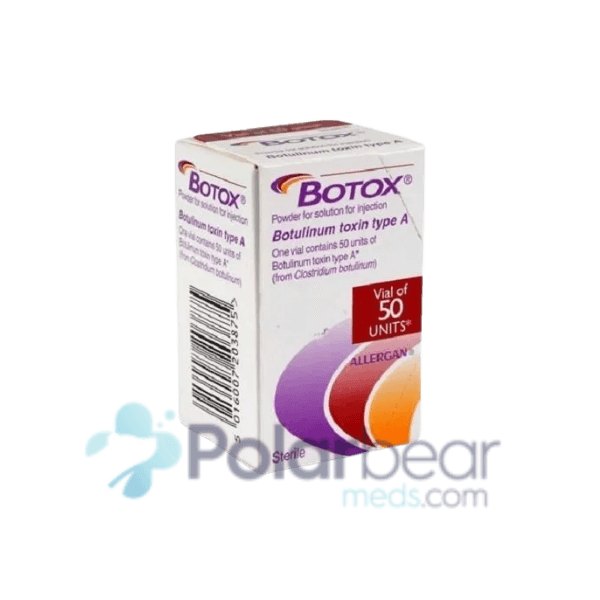
Botox Injection contains onabotulinumtoxinA, a purified neurotoxin produced by Clostridium botulinum. It is administered by injection to temporarily block nerve signals to targeted muscles or glands. This action helps reduce muscle activity or glandular secretion, depending on the medical condition being treated. Botox is used for both therapeutic and cosmetic indications and must be administered by a qualified healthcare professional.
| Category | Details |
|---|---|
| Generic Name | OnabotulinumtoxinA |
| Brand Name | Botox |
| Formulation | Vacuum‑dried powder for reconstitution for injection |
| Available Vial Sizes | • 50 Units vial (available on this product page) • 100 Units vial • 200 Units vial (availability may vary by supplier) |
| Reconstitution | Reconstitute with preservative‑free 0.9% Sodium Chloride Injection USP prior to administration. Dilution volume depends on the indication and dosing requirements. |
| Example Dilution (After Reconstitution) | Common dilution: 4 Units per 0.1 mL when a 100‑Unit vial is reconstituted with 2.5 mL preservative‑free saline. Actual concentrations vary by indication and clinician preference. |
| FDA‑Approved Indications (Cosmetic) | • Moderate to severe glabellar lines (frown lines) • Moderate to severe forehead lines • Moderate to severe lateral canthal lines (crow’s feet) |
| FDA‑Approved Indications (Therapeutic) | • Cervical dystonia • Blepharospasm • Strabismus • Chronic migraine • Overactive bladder • Upper and lower limb spasticity • Axillary hyperhidrosis |
| Administration | Intramuscular, intradermal, or intradetrusor injection by a trained healthcare professional. Sessions are generally not repeated more often than every 3 months. |
| Contraindications | • Hypersensitivity to botulinum toxin or formulation components • Infection at the proposed injection site |
| Boxed Warning | Spread of toxin effect: symptoms such as swallowing or breathing difficulties may occur and can be life‑threatening. |
| Common Adverse Reactions | • Eyelid ptosis • Brow ptosis • Headache • Injection‑site pain, swelling, bruising |
| Serious Risks | • Dysphagia • Dysphonia • Respiratory compromise • Generalized muscle weakness • Hypersensitivity reactions, including anaphylaxis |
| Use in Specific Populations | • Pregnancy: Use only if potential benefit justifies risk • Lactation: Unknown if excreted in human milk • Pediatric: Cosmetic safety not established |
| Store unopened vials refrigerated at 2–8°C (36–46°F). After reconstitution, keep refrigerated and use within 24 hours. Do not freeze the reconstituted solution. |
← Swipe to see more →

According to the FDA prescribing information, Botox (onabotulinumtoxinA) injection is approved for several therapeutic and cosmetic indications, including:
Therapeutic Uses
Cosmetic Uses

Botox Injection Boxed Warning: Distant Spread of Toxin Effect
The effects of Botox (onabotulinumtoxinA) and all botulinum toxin products can spread beyond the injection site, leading to symptoms consistent with botulinum toxin effects. These symptoms, which may include muscle weakness, difficulty swallowing, or breathing problems, have been reported hours to weeks after Botox Injection.
Swallowing & breathing difficulties can be life-threatening, and there have been reports of death. The risk of symptoms is probably greatest in children treated for spasticity, but symptoms can also occur in adults, particularly in people with an underlying condition that predisposes them to these symptoms.

Botox (onabotulinumtoxinA) injection works by temporarily blocking nerve signals to specific muscles or glands. When these signals are blocked, the targeted muscles cannot contract as strongly, which helps relax the muscles and reduce unwanted movement or wrinkles.
In some medical conditions, Botox also reduces nerve signals to glands, which can help decrease excessive sweating or other symptoms. The effects are temporary, and results usually last for several months before another treatment may be needed, as advised by a healthcare provider.

Botox doses may vary depending on patient response, muscle mass, and clinical indication. The injection administration should be performed by a trained healthcare expert according to FDA prescribing guidelines.
| Indication | Typical Total Dose | Injection Sites | Notes |
|---|---|---|---|
| Glabellar Lines (Frown Lines) | 20 Units | 5 sites (corrugator and procerus muscles) | Inject 4 Units per site |
| Lateral Canthal Lines (Crow’s Feet) | 24 Units | 6 sites (orbicularis oculi muscles) | Inject 4 Units per site |
| Forehead Lines (Frontalis) | 20 Units | 5 sites in the frontalis muscle | Commonly combined with glabellar treatment (total 40 Units) |
| Platysma Bands (Neck Lines) | 26–36 Units | 18–28 sites along platysma bands | Dose adjusted depending on severity |
| Chronic Migraine | 155 Units | 31 sites across the head and neck | Administer every 12 weeks using a fixed‑site injection protocol |
| Cervical Dystonia | Up to 200 Units (variable) | Multiple neck muscles | Dose is individualized depending on muscle involvement |
| Blepharospasm | 1.25–2.5 Units per site | Orbicularis oculi muscles | Repeat treatment about every 3 months if needed |
| Strabismus | 1.25–5 Units per muscle | Extraocular muscles | Dose depends on muscle size and deviation severity |
| Overactive Bladder | 100 Units | 20 sites in the detrusor muscle | Injected intradetrusor via cystoscopy |
| Axillary Hyperhidrosis | 50 Units per axilla (100 Units total) | Multiple intradermal injections | 50 Units injected in each axilla |
← Swipe to see more →
There is no specific “best” time of day to get Botox injections. Botox can be safely administered in the morning, afternoon, or evening. The most important factor is choosing a time when you can follow the after-care instructions for several hours after treatment.
Many providers recommend morning or early afternoon appointments because:
Ultimately, the best time is when you can relax after the procedure and follow your provider’s instructions properly.


Botox Injection can cause both common and rare/serious side effects. Most side effects are mild and temporary, but some may be serious and require medical attention right away. Below is a summary of Botox side effects:
| Common Side Effects of Botox Injection | Rare or Serious Side Effects of Botox Injection |
|---|---|
| Injection site reactions (redness, swelling, pain, bruising, itching) | Severe allergic reactions (difficulty breathing, swelling of face/lips, anaphylaxis) |
| Mild headache | Dysphagia (difficulty swallowing) |
| Eyelid ptosis (drooping eyelid) | Dysphonia (voice changes) |
| Brow ptosis (drooping brow) | Respiratory compromise (trouble breathing) |
| Localized muscle weakness near the injection site | Generalized muscle weakness due to toxin spread |
| Mild flu‑like symptoms (fatigue, malaise) | Vision problems if the toxin spreads to the eye muscles |
| Temporary dry eyes or tearing (with eye injections) | Rare hypersensitivity reactions |
← Swipe to see more →
Botox (onabotulinumtoxinA) should not be used in patients with the following conditions, as per FDA labeling:

Receiving too much Botox can cause serious side effects due to excessive muscle relaxation or toxin spread. Symptoms of a Botox overdose may include:
If you suspect a Botox overdose, seek medical attention immediately. Contact your provider or poison control center for urgent guidance.
Note: Prompt medical evaluation is critical, as severe overdosing can be life-threatening.

If you buy Botox Injection online from Canada, store it properly at home before your appointment:

Botox (onabotulinumtoxinA) may interact with certain medications or substances. Key Botox interactions include:
Always inform your provider of all medications, supplements, OTC medicines, and herbal products you are taking before receiving Botox Injection.

Common alternatives to Botox include other botulinum toxin type A products used for similar cosmetic and medical treatments:

The cost of Botox Injection in the U.S. can be high, and many patients face financial challenges when insurance coverage is limited. Delaying or skipping doses may affect treatment outcomes.
At Polar Bear Meds, we aim to make Botox more accessible and affordable by offering safe, licensed options online. By partnering with licensed Canadian pharmacies, we provide significant savings of up to 80-90% compared to U.S. pharmacy prices.

The information provided about the Botox Injection is for general educational purposes only and is not a substitute for any diagnosis, medical advice, or treatment. Botox Injection is a prescription medication and should be used only under the guidance of a healthcare provider. Always consult your healthcare provider, pharmacist, or doctor before starting, stopping, or changing any Botox treatment. This is especially true if you already have medical issues or are taking other medications.



Dr. Jackson Miller is a board-certified medicine physician & hospitalist. He is a healthcare professional with a strong background in patient care. With years of experience and a patient-first approach, he believes the foundation of good health is a patient who feels informed and empowered. He contributes to medical content review, drawing on his background in clinical practice and patient education. He focuses on presenting health information in a clear, accurate, and accessible way to help readers make informed decisions. His work emphasizes clarity, evidence-based guidance, and understandable explanations of medical topics.
Learn more about Botox Injection and related topics



We offer competitive pricing on all our medications. We'll match if you find a lower price on an identical product at a verified Canadian online pharmacy!
Need help? Call our sales team at 1-(888) 478-2193 or fill out the Contact Form