Microdosing Ozempic to Save Money? 2026 Costs & Alternatives
Key Takeaways
- Microdosing Ozempic is an unapproved method to lower monthly costs using fractional amounts.
- The official FDA label strictly requires disposing of opened pens after 56 days.
- Federal regulators warn that manual dosing and click counting create dangerous measurement errors.
- Paying retail prices for subtherapeutic doses stalls clinical progress and wastes your money.
- You can access reliable affordability through manufacturer assistance, insurance appeals, or verified Canadian sourcing.
Facing high retail prices forces many U.S. patients to rethink their treatment plans. Some intentionally take smaller amounts to make a single prescription last longer. Exploring microdosing Ozempic to save money seems like a quick financial fix. However, this unapproved method carries severe clinical and dosing risks. Stretching your medication creates a false economy that stalls real progress. Safer financial alternatives exist to protect your health and budget.
What Does Microdosing Ozempic Mean for U.S. Patients?
Microdosing Ozempic to save money means taking a tiny fraction of your prescribed medication. Patients inject less than the standard therapeutic dose of semaglutide approved by federal regulators. Many uninsured individuals use microdosing to afford GLP-1 therapy long term. They stretch one expensive brand-name pen across extra weeks.
Others reduce their weekly amounts to manage severe Ozempic gastrointestinal side effects. They hope smaller doses will prevent intense nausea or vomiting. Modifying your official schedule without a doctor's supervision is strictly an off-label Ozempic use. This unapproved practice lacks formal safety data and clinical oversight.
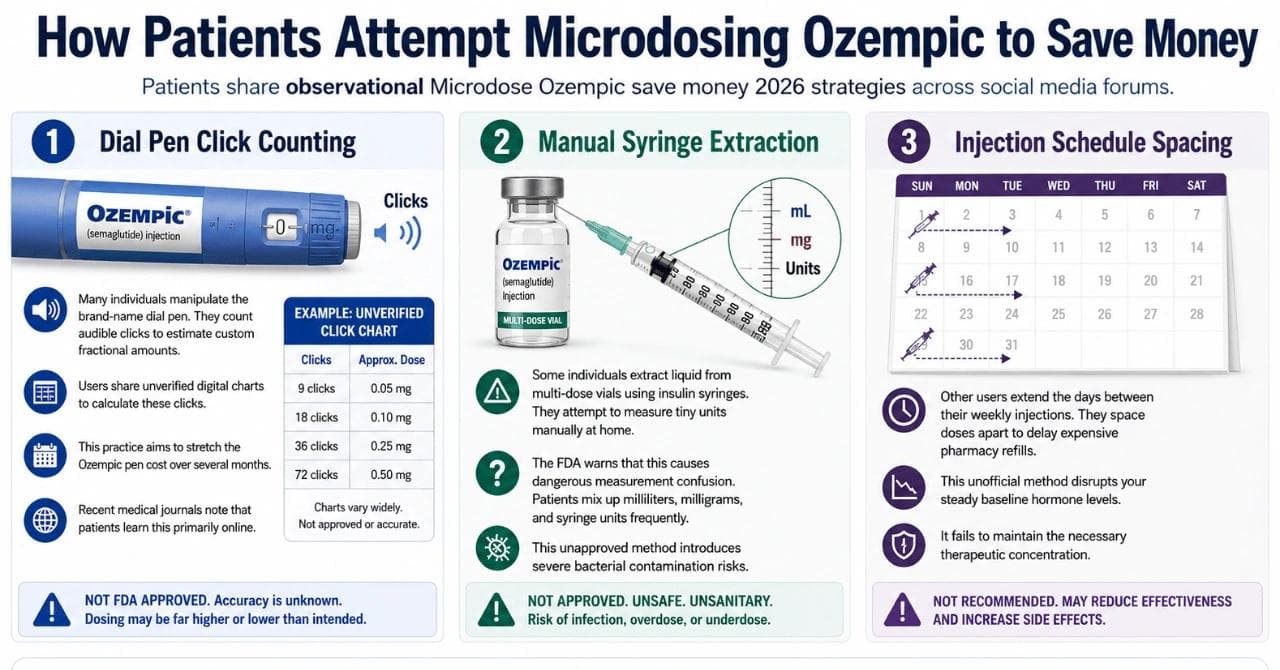
How Patients Attempt Microdosing Ozempic to Save Money
Patients share observational Microdose Ozempic save money 2026 strategies across social media forums.
- Dial Pen Click Counting: Many individuals manipulate the brand-name dial pen. They count audible clicks to estimate custom fractional amounts. Users share unverified digital charts to calculate these clicks. This practice aims to stretch the Ozempic pen cost over several months. Recent medical journals note that patients learn this primarily online.
- Manual Syringe Extraction: Some individuals extract liquid from multi-dose vials using insulin syringes. They attempt to measure tiny units manually at home. The FDA warns that this causes dangerous measurement confusion. Patients mix up milliliters, milligrams, and syringe units frequently. This unapproved method introduces severe bacterial contamination risks.
- Injection Schedule Spacing: Other users extend the days between their weekly injections. They space doses apart to delay expensive pharmacy refills. This unofficial method disrupts your steady baseline hormone levels. It fails to maintain the necessary therapeutic concentration.
The 56-Day Rule: Why Stretching Prescriptions Fail
Stretching your medication creates severe physical hazards. The official FDA label contains a strict expiration timeline. You must discard an opened pen after exactly 56 days. This applies even if the medication remains inside the device.
Using a pen for three or four months violates basic safety protocols. The sterile preservative loses its effectiveness over extended periods. This exposes your body to dangerous bacterial contamination. Ignoring this rule compromises the chemical stability of your treatment.
What FDA Warnings Say About Ozempic Dosing Errors
Federal regulators actively monitor unapproved injection practices. The FDA recently issued alerts regarding compounded semaglutide products. Self-administered dosing errors cause severe adverse health events. Some calculation mistakes have required immediate patient hospitalization.
Patients frequently confuse milligrams, milliliters, and syringe units. Manual measurement lacks the precision of factory-calibrated devices. Altering your dose creates highly unpredictable blood sugar drops. Regulators emphasize that you must use appropriate, approved delivery systems safely.
Does Microdosing Ozempic Actually Save Money?
Patients calculate theoretical microdose Ozempic cost savings by dividing weekly amounts. However, separating immediate math from real medical outcomes reveals a massive financial risk.
| Financial Factor | The Microdosing Illusion | The Standard Dose Reality |
|---|---|---|
| Upfront Purchase | High initial retail price for one pen. | High initial retail price for one pen. |
| Refill Timeline | Stretches one pen over two or three months. | Uses one complete pen every 28 days. |
| Medication Waste | Unused liquid must be thrown away after 56 days. | Medication is fully consumed before it expires. |
| Insurance Status | Off-label use risks losing your prior authorization. | Approved use keeps your insurance coverage active. |
| Clinical Value | Fails to hit metabolic targets for weight loss. | Matches clinical trials for proven medical success. |
← Swipe to see more →
Comparing microdosing GLP-1 vs. regular dose results exposes a false economy. Paying retail prices for subtherapeutic amounts wastes your health budget. You lose vital glycemic protections completely. Stalled progress means you spend money without seeing real benefits. Throwing away expired medication after 56 days destroys your calculated savings entirely.
Alternatives Patients Explore Instead of Microdosing Ozempic
Patients exploring Microdosing Ozempic to save money often compare several regulated affordability options before changing refill schedules independently.
| Alternative Pathway | Why Patients Explore It |
|---|---|
| Manufacturer Support Programs | Some patients review Ozempic savings card eligibility and the Novo Nordisk patient assistance program for lower out-of-pocket costs. |
| Insurance Appeals | Patients may request formulary exceptions or review updated Medicare Part D GLP-1 coverage policies. |
| Manufacturer Direct-Pay Options | Some Americans compare available manufacturer direct-pay program pricing instead of reducing doses independently. |
| Licensed Canadian Fulfillment | Some patients research regulated pharmacies to buy Ozempic online in Canada while maintaining standard refill schedules. |
← Swipe to see more →
Many patients now focus on long-term affordability rather than temporary monthly reductions. That shift became more noticeable after compounded semaglutide restrictions tightened in 2025 and 2026.
The Bottom Line: Evaluating Your 2026 Costs & Alternatives
Stretching your prescription independently creates a false economy that stalls real medical progress. Fluctuating weekly doses fall outside approved guidelines and fail to maintain consistent targets. The strict 56-day expiration rule also limits any true long-term financial savings. Patients now focus on establishing regulated affordability pathways instead of altering injection schedules.
Reviewing official manufacturer programs or international fulfillment helps secure predictable pricing safely. Securing standard dose medication through verified channels offers reliable stability for your health journey. Review available treatment options and pricing to maintain your prescribed health regimen securely.
Frequently Asked Questions
No. Ozempic was approved using specific dosing schedules reviewed through formal evaluation. Independent dose adjustments lack clinical endorsement and remain completely unapproved.
Most online discussions center on severe affordability concerns. High retail pharmacy pricing drives individuals to search for lower cost management strategies.
Click counting involves patients estimating custom fractional amounts using the dial pen mechanism. The pens are not officially calibrated for unapproved fractional increments.
Regulators have reported dosing confusion cases involving self-measured administration errors. Altered schedules may also create highly inconsistent medication exposure in your body.
The official FDA label states that opened pens must be discarded after exactly 56 days. Using pens beyond this window violates strict manufacturer sterility protocols.
Not consistently. Reducing weekly amounts lowers immediate spending temporarily. However, paying retail prices for subtherapeutic doses often fails to deliver lasting metabolic value.
As national shortages eased, federal enforcement around compounded copies increased significantly. This reduced access to some lower-cost compounded products previously used during shortage periods.
Patients frequently explore manufacturer assistance programs or submit formal formulary appeals. Many individuals also review regulated international pharmacy sourcing for standard dose fulfillment.
No. A prescribed maintenance dose follows approved medical supervision and labeled prescribing structures. Unofficial microdosing discussions involve independent dose adjustments outside standard schedules.
If cost is the primary issue, some patients consult their doctors about oral alternatives. You must always discuss FDA-approved substitutes with your healthcare provider directly.
Disclaimer
This blog is provided for informational purposes only and does not replace professional medical, insurance, financial, or prescription guidance. Pricing, availability, prescription requirements, shipping timelines, and medication access policies may change over time and vary by provider, pharmacy source, and insurance plan. Always consult your healthcare provider, insurance representative, or official government resources before making medication, prescription, or coverage decisions.