



We offer competitive pricing on all our medications. Find a lower price? We'll match it from any verified Canadian online pharmacy! Know More
Strength
Quantity
To Place OrderCall 1-(888)-478-2193
 Ships from Canada

We offer competitive pricing on all our medications. Find a lower price? We'll match it from any verified Canadian online pharmacy! Know More

Dr. Jackson Miller is a board-certified medicine physician & hospitalist. He is a healthcare professional with a strong background in patient care. With years of experience and a patient-first approach, he believes the foundation of good health is a patient who feels informed and empowered. He contributes to medical content review, drawing on his background in clinical practice and patient education. He focuses on presenting health information in a clear, accurate, and accessible way to help readers make informed decisions. His work emphasizes clarity, evidence-based guidance, and understandable explanations of medical topics.
Ordering your medication online is simple and convenient.
Select the prescribed dosage and quantity, then proceed to checkout.
Sign in or create a new account.
Upload your prescription.
Complete your purchase by processing the payment.
Select the prescribed dosage and quantity, then proceed to checkout.
Sign in or create a new account.
Upload your prescription.
Complete your purchase by processing the payment.
Shipping takes approximately 3-5 business days.

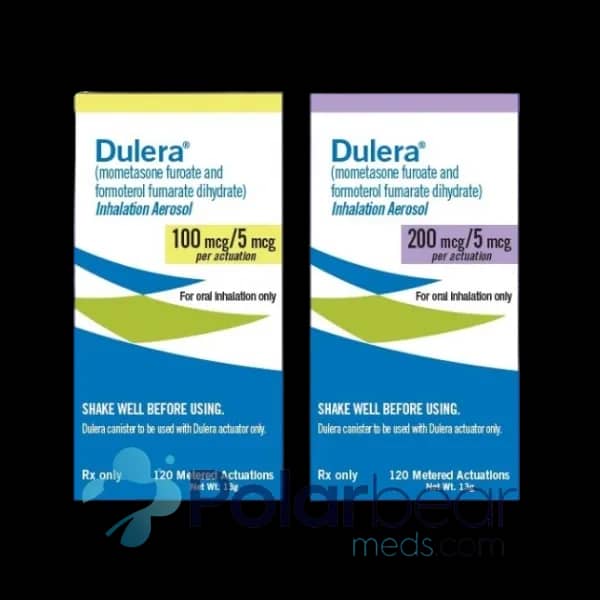
Dulera is a prescription inhaler used for the maintenance treatment of asthma in adults & children aged 5 years and older. It contains a combination of mometasone furoate, an inhaled corticosteroid, and formoterol fumarate, a long-acting bronchodilator.
The medication is approved by the FDA for long-term asthma control and should be used regularly as prescribed by a healthcare provider. Dulera is not intended for sudden asthma attacks and should be used alongside a rescue inhaler for quick relief if needed.
| Category | Information |
|---|---|
| Generic Name | Mometasone furoate + Formoterol fumarate dihydrate |
| Brand Name | Dulera |
| Drug Class | Combination: Long‑acting beta2‑adrenergic agonist (LABA) + Corticosteroid (ICS) |
| FDA Approval | First approved June 22, 2010; pediatric labeling expanded August 12, 2019 |
| Indication | Treatment of asthma in patients ≥5 years old; not for acute bronchospasm or status asthmaticus |
| Dosage Forms & Strengths | Inhalation aerosol: 50 mcg/5 mcg, 100 mcg/5 mcg, 200 mcg/5 mcg (mometasone/formoterol per actuation) |
| Contraindications | • Hypersensitivity to ingredients • Primary treatment of status asthmaticus or acute asthma episodes |
| Key Warnings & Precautions | • LABA monotherapy raises the risk of serious asthma‑related events • Do not use with another LABA • Risk of oral Candida infection (rinse mouth after use) • Immunosuppression: may worsen infections (TB, herpes, measles, chickenpox) • Risk of adrenal suppression, hypercorticism • Paradoxical bronchospasm possible • Monitor bone mineral density, growth in children, and ocular effects (glaucoma, cataracts) • Use cautiously in cardiovascular disorders, diabetes, thyroid disease |
| Common Adverse Reactions | Nasopharyngitis, sinusitis, headache |
| Serious Adverse Reactions | Asthma‑related death (with LABA monotherapy), adrenal suppression, growth reduction in children, ocular complications |
| Pediatric Use | • Established safety/efficacy in ages 5–11 years (50 mcg/5 mcg strength) • Not established in children <5 years • May reduce growth velocity (~1 cm/year) in children; growth should be monitored routinely |
| Storage | Store at room temperature 20–25°C (68–77°F), with permitted excursions between 15°C and 30°C (59°F to 86°F). Avoid heat or open flame. Do not puncture or expose the canister to temperatures above 49°C (120°F), as it may burst. |
| Legal Status | Prescription only (Rx) |
← Swipe to see more →

Dulera works by combining two medications that help control asthma symptoms and improve breathing over time.
Together, these two ingredients help reduce airway inflammation and maintain open airways, allowing better airflow to the lungs.

Dulera is a combination asthma inhaler that contains two active medications along with inactive ingredients that help deliver the drug effectively into the lungs.
| Ingredient | Drug Class | Purpose |
|---|---|---|
| Mometasone furoate | Inhaled corticosteroid (ICS) | Reduces inflammation and swelling in the airways to help prevent asthma symptoms. |
| Formoterol fumarate | Long‑acting beta₂‑agonist (LABA) | Relaxes airway muscles and helps keep the airways open for easier breathing. |
← Swipe to see more →
| Ingredient | Role in the Dulera Inhaler |
|---|---|
| Hydrofluoroalkane (HFA‑227) propellant | Helps deliver the medication as an aerosol spray into the lungs. |
| Ethanol (alcohol) | Acts as a solvent to keep the medication evenly mixed. |
| Oleic Acid | Acts as a stabilizing agent that helps maintain proper formulation and aerosol performance. |
← Swipe to see more →
Important: These ingredients are listed according to the FDA-approved prescribing information for Dulera. Patients who have allergies to any component of the inhaler should consult their healthcare provider before use.

Consider the following Dulera administration guidelines for safe use:

Dulera inhaler dosages may vary depending on the patient’s age, asthma severity, and treatment response. Below are Dulera dosage for asthma management:
| Patient Group | Typical Dosage |
|---|---|
| Adults and adolescents (12 years and older) | 2 inhalations twice daily (morning and evening). Available strengths: 100 mcg/5 mcg or 200 mcg/5 mcg per inhalation. |
| Children (5–11 years) | 2 inhalations of 50 mcg/5 mcg twice daily as prescribed by a doctor. |
← Swipe to see more →
Dulera side effects may include:
| Common Side Effects of Dulera | Mild Side Effects of Dulera | Rare or Serious Side Effects of Dulera |
|---|---|---|
| Nasopharyngitis (common cold symptoms) | Hoarseness or voice changes | Paradoxical bronchospasm (sudden breathing difficulty) |
| Headache | Throat irritation | Severe allergic reactions |
| Sinusitis | Mild cough | Adrenal suppression |
| Upper respiratory infection | Oral thrush (oral candidiasis) | Decreased bone mineral density |
| Flu‑like symptoms | Dry mouth | Eye problems (glaucoma or cataracts) |
| Back pain | Mild nausea | Cardiovascular effects (fast heart rate, high blood pressure) |
| — | Muscle cramps | Hypokalemia (low potassium levels) |
| — | — | Hyperglycemia (increased blood sugar levels) |
← Swipe to see more →

Seek medical advice if your asthma symptoms worsen, if your rescue inhaler becomes less effective, or if you experience severe side effects such as chest pain, rapid heartbeat, or worsening breathing problems.

Dulera can interact with several medications. Here are some Dulera interactions you should know about:
| Drug / Drug Class | Drug Examples | Possible Interaction |
|---|---|---|
| Strong CYP3A4 inhibitors | Ketoconazole, Itraconazole, Ritonavir, Clarithromycin | May increase systemic exposure to mometasone, raising the risk of corticosteroid side effects such as adrenal suppression and Cushing‑like effects. |
| Beta‑blockers | Propranolol, Atenolol, Metoprolol | May block the bronchodilator effect of formoterol and can trigger bronchospasm in asthma patients. |
| Diuretics (non‑potassium sparing) | Furosemide, Hydrochlorothiazide | May increase the risk of hypokalemia and ECG changes when used with beta‑agonists like formoterol. |
| Tricyclic antidepressants / MAO inhibitors | Amitriptyline, Phenelzine, Tranylcypromine | May potentiate the cardiovascular effects of beta‑agonists, increasing the risk of arrhythmias and hypertension. |
| Other LABA medications | Salmeterol, Indacaterol, Olodaterol | Concomitant use may increase the risk of overdose and serious asthma‑related events; it should generally be avoided. |
| Systemic corticosteroids | Prednisone, Dexamethasone | May increase overall corticosteroid exposure, raising the risk of adrenal suppression and systemic steroid effects |
← Swipe to see more →

When considering Dulera alternatives, here are some options to help manage asthma symptoms:

The cost of asthma medications like Dulera can be significantly higher in the U.S., making long-term treatment difficult for many patients. To help reduce this burden, many people choose to buy Dulera online from Canada through trusted international pharmacy services such as Polar Bear Meds.
When you order Dulera inhaler online, you may be able to save substantially compared with typical U.S. retail pharmacy prices. Polar Bear Meds works with licensed Canadian and international pharmacies to source medications that meet strict safety and quality standards. This helps ensure patients receive genuine prescription medications while managing the cost of ongoing asthma treatment.
New customers can also take advantage of a Dulera coupon code “WELCOMEPB10”, which provides 10% off the first order. In addition, many orders qualify for fast delivery through Xpress Post, typically arriving within 3–5 business days, depending on location and pharmacy fulfillment.

The information provided here is for general educational purposes only and should not be considered medical advice. Dulera is a prescription medication used for the maintenance treatment of asthma. Always consult a licensed doctor before starting, stopping, or changing any medication. Do not rely solely on this information for medical decisions. This information is based on official prescribing information, clinical drug databases, and trusted medical organizations.

Learn more about Dulera and related topics



We offer competitive pricing on all our medications. We'll match if you find a lower price on an identical product at a verified Canadian online pharmacy!
To Place Order, call 1-(888) 478-2193 or fill out the Contact Form
Rated 4.9/5 Verified Reviews on Shopper Approved
