Traveling with GLP-1 Medications 2026: The Complete US Patient Guide
Key Takeaways
- TSA exempts medically necessary injectables from the 3-1-1 liquid rule, declare them proactively at the checkpoint.
- Gel ice packs in any physical state are permitted through airport security when used for medication.
- The FDA's personal importation policy allows US patients to bring or order up to a 90-day supply from a licensed Canadian pharmacy with a valid prescription.
- As of early 2026, Canada became the first G7 country to approve generic semaglutide, dropping local prices to roughly $183.99 per month.
Traveling with GLP-1 medications 2026 means managing temperature-sensitive injectables, sharps disposal, customs paperwork, and refill timing, all while trying to actually enjoy your trip. This guide covers the practical logistics US patients need: what TSA allows, how to keep pens cold, what customs expects, and how the new Canadian generic options affect your refill strategy.
GLP-1 Medications and the Realities of Traveling with Injectables
Ozempic, Wegovy, Mounjaro, and Zepbound have changed how millions of US patients manage weight and blood sugar. But they've also created a new set of travel headaches that insulin users have dealt with for years: pens that need refrigeration, syringes and needles that trigger security questions, and dosing schedules that don't pause for time zones.
The challenges are real. These medications must stay cold during transit, require proper sharps disposal wherever you go, and need refills timed so you don't run short mid-trip. Crossing an international border adds customs declarations and destination-country rules to the list.
This guide walks through every scenario: flying domestically and abroad, cruise travel, road trips, and business travel. It also covers the refill math, because for many US patients paying cash, that's the part that shapes every other decision.
Flying with GLP-1s: TSA Rules Every Injectable User Needs to Know
Airport security is the part most patients worry about first. Traveling with prescription medication in the US is generally straightforward when you understand TSA requirements for injectable medications and carry the appropriate documentation. The good news is that TSA rules are clear and genuinely workable for injectable medication users.
The 3-1-1 Exemption for Medically Necessary Injectables
The standard 3-1-1 liquid rule doesn't apply to medically necessary medications. According to TSA guidelines, medically necessary liquids, including GLP-1 injectables like semaglutide and tirzepatide pens, are allowed in carry-on bags in quantities larger than 3.4 oz. You do need to declare them to a TSA officer at the checkpoint. That's it. No special form, no advance registration. Just separate the medication from your other liquids and tell the officer what it is.
Keep everything in its original labeled packaging. A prescription label with your name, the drug name, and your prescriber's contact information makes the conversation much shorter. Officers can and do ask follow-up questions, so being proactive beats waiting to be flagged.
Syringes and Needles in Carry-On Bags
TSA permits unused syringes in both carry-on and checked baggage when they're accompanied by the injectable medication. So if you're carrying separate pen needles along with your Ozempic or Mounjaro, that's allowed, provided the medication travels with them. Don't pack syringes separately in a bag that doesn't also contain the injectable.
Gel Ice Packs and Portable Coolers
Here's a rule that surprises a lot of travelers: TSA allows medically necessary gel ice packs through security checkpoints regardless of their physical state. Melted, slushy, or fully frozen, they're permitted when used to keep medications cold. This matters because ice packs often start melting in a warm security line. You don't need to dump them.
Insulated travel cases with gel ice packs are the most practical option for most flights. For longer international trips, USB-powered mini coolers are worth considering, though you'll want to confirm the airline allows the battery size before you fly.
Keep your medication, cool pack or gel ice pack, and any medical supplies together in one clearly organized pouch. It signals to officers that this is medical equipment, not an attempt to circumvent the rules.
Keeping GLP-1s Cold: Refrigeration from Home to Destination
Temperature sensitivity is the defining logistics challenge for semaglutide and tirzepatide users. These aren't medications you can toss in a bag and forget.
What "Room Temperature" Actually Means
Manufacturer guidance (reflected in prescribing information) specifies the temperature windows for these pens, both for refrigerated medication storage and for the limited time they can be kept at room temperature before use. Check the specific guidance for your medication, because the window varies. The key point: "room temperature" doesn't mean a hot car, a sunny windowsill, or a bag left on a beach chair.
Choosing Your Cold Storage Option
For most domestic flights and weekend trips, a well-insulated travel case with gel ice packs works fine. For multi-week trips or cruises, a small USB-powered or battery-operated cooler gives you more control and doesn't depend on finding ice.
If you're on a road trip, never put your pen in a glove box or trunk. Parked cars in warm weather can reach temperatures far beyond what these medications can survive, and that happens faster than most people expect. A small insulated bag on the back seat is a better option.
Hotel and Airbnb Refrigeration
Before you book, confirm refrigeration access. Most hotels have mini-fridges in rooms, but mini-fridge temperatures vary. If you need consistent cold storage, call ahead and ask whether a medical-grade refrigerator is available, or whether the hotel can store your medication at the front desk. Many will accommodate this with advance notice.
Airbnb hosts can be messaged directly. A brief note explaining you're traveling with prescription medication that requires refrigeration usually gets a straightforward response.
If Your Pen Gets Too Warm
This is where many patients panic unnecessarily, or worse, use a pen that's been compromised. If your medication has been exposed to temperatures outside the recommended range, contact your prescriber or pharmacist before using it. Don't guess. A pen that looks fine may have degraded. Replacing it is cheaper than managing a missed dose of medication that's no longer effective.
International Travel: Customs Rules and the FDA Personal Importation Policy
Flying with Ozempic internationally or carrying any GLP-1 injectable across borders adds another layer that domestic travel doesn't: customs regulations for GLP-1s vary by country, making advance planning essential.
The FDA's 90-Day Personal Importation Policy
The FDA's personal importation policy is one of the most useful tools available to US patients managing expensive prescriptions. Under this policy, individuals can bring or ship up to a 90-day supply of prescription drugs into the United States for personal use.
This applies whether you're carrying medication across the Canadian border in person or ordering ahead from a licensed Canadian pharmacy and having it shipped to your US address before you travel. Either way, the FDA guidelines support it.
Why Original Packaging and Prescription Labels Matter
At customs, original packaging with a legible prescription label is your documentation. It tells the officer who prescribed the medication, what it is, and who it belongs to. Transferring pens into unlabeled cases or zip-lock bags removes that documentation and can create unnecessary delays.
Carry a copy of your prescription or a doctor's note as a backup. Some travelers also carry a brief travel certificate or letter from their prescriber explaining the medication and the diagnosis. It's not required under FDA guidelines, but it can smooth things over at international checkpoints.
Researching Your Destination Country's Rules
Not every country treats GLP-1 injectables the same way. Destination-specific rules for importing prescription medications vary, and it's worth researching before you depart. Your prescriber, the destination country's embassy website, or a travel medicine clinic are good starting points. Don't assume that because it's legal to use in the US, it's automatically cleared for import elsewhere.
Canada's 2026 Generic Semaglutide Approval: A New Option for US Travelers
As of April and May 2026, Health Canada approved the first generic semaglutide injections, making Canada the first G7 country to approve a generic version of the medication. That approval included generics from Dr. Reddy's and Apotex, and as of May 2026, local Canadian pricing has dropped to roughly $183.99 per month.
For US patients crossing into Canada or ordering ahead through a licensed Canadian pharmacy, the FDA's 90-day importation policy creates a legal path to access that pricing. Combined with temperature-controlled shipping, this is a genuinely different cost picture than what most US patients face at home.
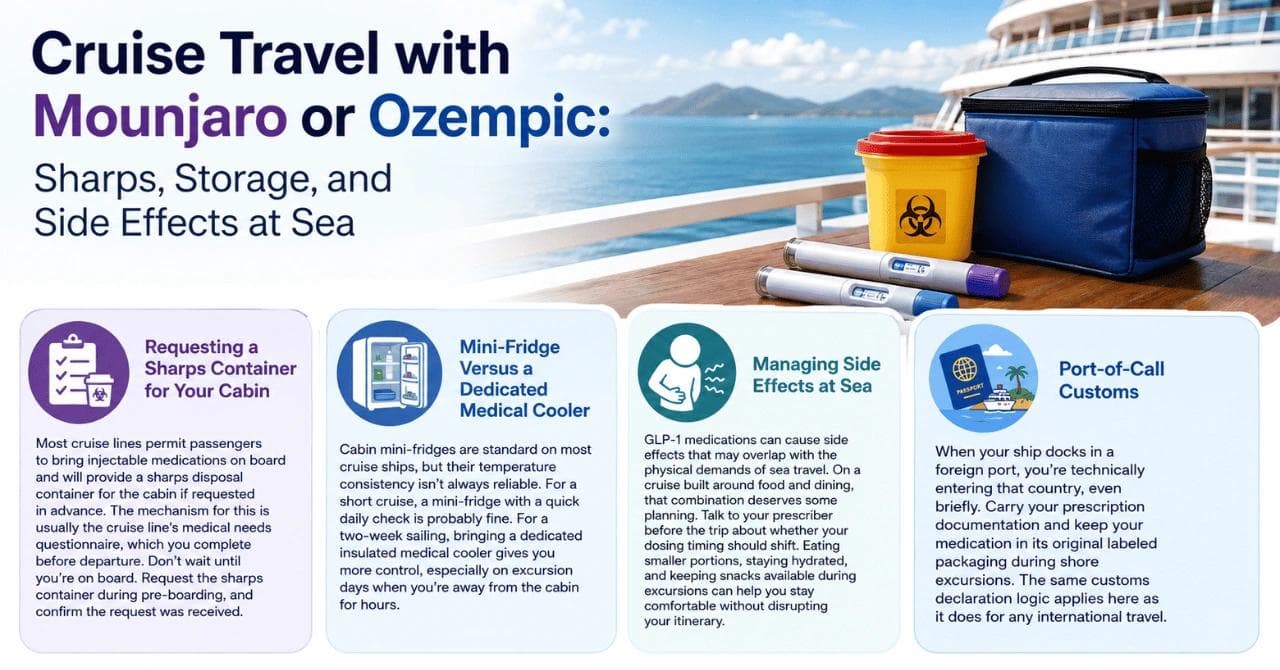
Cruise Travel with Mounjaro or Ozempic: Sharps, Storage, and Side Effects at Sea
Cruise travel with injectable medications has its own set of considerations, but cruise lines are generally well-prepared for passengers who need them.
Requesting a Sharps Container for Your Cabin
Most cruise lines permit passengers to bring injectable medications on board and will provide a sharps disposal container for the cabin if requested in advance. The mechanism for this is usually the cruise line's medical needs questionnaire, which you complete before departure. Don't wait until you're on board. Request the sharps container during pre-boarding, and confirm the request was received.
Mini-Fridge Versus a Dedicated Medical Cooler
Cabin mini-fridges are standard on most cruise ships, but their temperature consistency isn't always reliable. For a short cruise, a mini-fridge with a quick daily check is probably fine. For a two-week sailing, bringing a dedicated insulated medical cooler gives you more control, especially on excursion days when you're away from the cabin for hours.
Managing Side Effects at Sea
GLP-1 medications can cause side effects that may overlap with the physical demands of sea travel. On a cruise built around food and dining, that combination deserves some planning. Talk to your prescriber before the trip about whether your dosing timing should shift. Eating smaller portions, staying hydrated, and keeping snacks available during excursions can help you stay comfortable without disrupting your itinerary.
Port-of-Call Customs
When your ship docks in a foreign port, you're technically entering that country, even briefly. Carry your prescription documentation and keep your medication in its original labeled packaging during shore excursions. The same customs declaration logic applies here as it does for any international travel.
Road Trips and Business Travel: Doses, Hot Cars, and Time Zones
Business travel with Wegovy, Ozempic, or Mounjaro often creates different challenges than a vacation because you're juggling meetings, flights, and refrigeration at the same time.
Hot Cars Are the Biggest Risk
A parked car in warm weather becomes a heat trap quickly. Glove boxes and trunks are the worst spots: they get hot faster and stay hot longer than the passenger cabin. Your GLP-1 pen should never be stored there. Keep it in an insulated bag on the back seat or in a small portable cooler, especially during summer road trips.
If you're stopping for the night, bring the medication inside with you. Don't leave it in the car overnight, even in cooler weather.
Travel-Sized Sharps Containers
Small, puncture-resistant sharps containers designed for travel are widely available and meet airline and hotel disposal requirements. Pack one. Hotels generally don't have sharps disposal for guests, and improvising with a water bottle or a plastic bag creates a safety risk. Some medical supplies designed for injection users include travel-sized sharps options worth having on hand.
Adjusting for Time Zones
Dosing schedules for injectable GLP-1 medications can require some thought when you're crossing multiple time zones. Check with your prescriber before a major time-zone shift, especially on an international business trip. Don't just guess at a new schedule mid-trip.
Business Travel Without Refrigeration Gaps
Multi-city business travel creates gaps: early morning flights, back-to-back meetings, hotel check-ins delayed until evening. Plan your refrigeration handoffs. Know when you're checking in, whether the hotel has a fridge, and whether you need to carry a cooler through a full day of meetings. A small insulated pouch with a gel ice pack handles most same-day situations without drawing attention.
Whether you're planning a road trip or a cross-country drive, keeping your medication cool should remain a priority.
Refill Planning and Cost: Why Canadian Pharmacies Matter for US Patients in 2026
Traveling with GLP-1 medications in 2026 means confronting the cost reality head-on. Refill timing isn't just a logistics question; it's a financial one for most US patients paying cash.
What US Patients Are Actually Paying
As of mid-2026, the US retail list price for Zepbound sits at $1,086.37 per month, according to Forbes Health. Manufacturer direct-to-consumer programs offer some relief: self-pay patients can access Wegovy starting at $199 per month through the manufacturer's direct pharmacy program, as of July 2026. These programs have eligibility conditions and can change, so they're worth checking directly.
Canada's Generic Semaglutide Approval Changes the Math
The April and May 2026 Health Canada approvals of generic semaglutide from Dr. Reddy's and Apotex created a new option. Canada is the first G7 country to reach this milestone. As of July 2026, local Canadian pricing has dropped to roughly $183.99 per month. For US patients, that's a meaningful difference from US retail pricing.
The table below compares the main access routes available to US patients as of 2026.
| Access Route | Approx. Monthly Cost | Key Requirement | 90-Day Supply Available? |
|---|---|---|---|
| US retail (cash price) | ~$1,086.37/month (Zepbound list price, as of mid-2026) | Valid US prescription | Yes, but at full cost |
| US manufacturer direct program | Starting at $199/month (Wegovy, as of July 2026) | Eligibility conditions apply | Varies by program |
| Licensed Canadian pharmacy (brand) | Lower than US retail; varies by medication | Valid prescription, FDA guidelines for personal importation | Yes, up to 90-day supply |
| Licensed Canadian pharmacy (generic semaglutide) | ~$183.99 USD/month (as of May 2026) | Valid prescription, FDA guidelines for personal importation | Yes, up to 90-day supply |
← Swipe to see more →
The FDA's personal importation policy allows US patients to order up to a 90-day supply from a licensed Canadian pharmacy with a valid prescription or English-language doctor's note. Ordering a 90-day supply before a long trip eliminates mid-trip shortages and avoids the scramble of finding a pharmacy abroad.
Practical Refill Timing Before You Travel
If you're planning a trip longer than a few weeks, order your refill before departure. A 90-day supply ordered through a licensed Canadian pharmacy like Polar Bear Meds, which requires a valid prescription and ships with temperature-controlled packaging, gives you a buffer against insurance gaps, travel delays, and supply disruptions. You can upload your prescription directly and have the order processed before you leave. Patients who've used this route can read what others have said about the process.
If you're already a patient, refilling your prescription through a Canadian pharmacy before a long trip is straightforward. The medication ships cold-chain to your US address, so you're not managing importation logistics yourself at the border.
For patients new to this option, the how-to-order guide walks through each step, including what prescription documentation is needed and how shipping works.
Frequently Asked Questions
If you have concerns about X-ray screening, you can request a manual inspection at the checkpoint. Talk to your prescriber or pharmacist if you have specific questions about how screening may affect your medication.
This varies by destination. Destination-specific rules for importing prescription medications differ, and researching the rules before departure is worth the effort. Check with the destination country's embassy or a travel medicine clinic before you go.
Contact your prescriber immediately, as they may be able to send an emergency prescription to a local pharmacy. Coverage and availability vary widely by country, and some destinations may not stock your specific brand, so a backup supply is worth planning ahead.
Coverage for prescription medications varies significantly by policy and insurer. Review your policy's prescription drug language before traveling, and ask your insurer directly about injectable medications.
Disclaimer
This article is informational and doesn't replace advice from your doctor or pharmacist. GLP-1 medications involve individual dosing, storage, and health considerations that vary by patient. Before traveling with any prescription medication or changing how you source or time your refills, talk to your prescriber. A quick conversation can prevent a lot of avoidable problems on the road.