How to Travel with Ozempic: A Road Tripper's Guide to Keeping Pens Safe
Key Takeaways
- Unused Ozempic pens must remain refrigerated at 36°F to 46°F, whereas opened pens can be stored at room temperature up to 86°F for up to 56 days.
- As of July 2026, TSA permits medically necessary gel ice packs through security checkpoints in any physical state when declared at the checkpoint.
- Never freeze an Ozempic pen, and never store it in a trunk or glove compartment during summer driving.
Knowing how to travel with Ozempic is mostly a temperature problem, and temperature problems have practical solutions. This guide provides practical travel tips covering storage rules, cooling gear, hotel logistics, and keeping your weekly dose on schedule.
Why Ozempic Temperature Control Can Make or Break a Road Trip
Semaglutide is a GLP-1 agonist prescription medication that should be stored within the recommended temperature range. Exposure to excessive heat or freezing may reduce the medication's stability and effectiveness, even if no visible changes are apparent. You won't always be able to tell by looking at it, which makes the stakes higher.
The opened-versus-unopened distinction changes your entire planning approach. An unused pen needs continuous refrigeration at 36°F to 46°F until its first injection. An in-use pen has a genuine travel asset built in: it can stay at room temperature, up to 86°F, for up to 56 days before it must be discarded.
That 86°F ceiling matters a lot on a summer drive. Car interiors routinely exceed that threshold in warm weather, and trunks can spike far higher. Passive storage in a hot vehicle isn't a gray area. It's a medication safety failure.
Ozempic Storage Rules: The Numbers Every Traveler Needs
Understanding the correct Ozempic storage temperature is essential before any trip. Unused pens require refrigeration at 36°F to 46°F (2°C to 8°C) until first use. In-use pens are safe at 59°F to 86°F (15°C to 30°C) for up to 56 days, then must be discarded regardless of how much medication remains.
Two hard limits apply in every situation. First, never freeze the pen. Freezing destroys the medication, and a frozen pen must be discarded, not thawed and used. Second, always keep the cap on when the pen isn't in use. Light degrades the medication, so cap-off storage is a slow version of the same problem.
For multi-day temperature math, the 56-day window is your planning tool. If you're on day 10 of an opened pen and your road trip runs 12 days, you have 34 days of room-temperature margin remaining. For shorter trips with an in-use pen, you may not need any refrigeration at all, as long as the ambient temperature stays below 86°F. This flexibility reduces the need for continuous refrigeration during short trips in moderate temperatures. Unopened backup pens are a different story, including those that need cold-chain maintenance the entire trip.
Ozempic Cooler for Travel: Which Option Fits Your Drive
Choosing the right Ozempic cooler for travel depends on three variables that includes trip length, whether your pens are opened or unopened, and how much gear you want to carry. Here's how the main options compare.
| Option | Power Needed | Approx. Temp Hold | Best For |
|---|---|---|---|
| Dedicated medical cooler (e.g. 4AllFamily, Frio) | None | Varies by model and ambient temp | Multi-day trips, opened or unopened pens |
| Insulated bag with gel packs | None | Hours to roughly a day | Day trips or short legs |
← Swipe to see more →
Dedicated medical coolers, sometimes marketed as insulin coolers, including options like 4AllFamily and Frio, are also suitable for Ozempic pen injectors. They don't require power, which makes them practical for travel scenarios where outlets aren't guaranteed. Hold times vary by model and outside temperature, so check the product specs against your expected conditions.
An insulated bag with gel packs is the lowest-cost approach and the most common one. It works well for short legs or day trips, but the reliable hold window is measured in hours, not days. For multi-day travel with unopened pens, it's a risky primary solution without a backup plan.
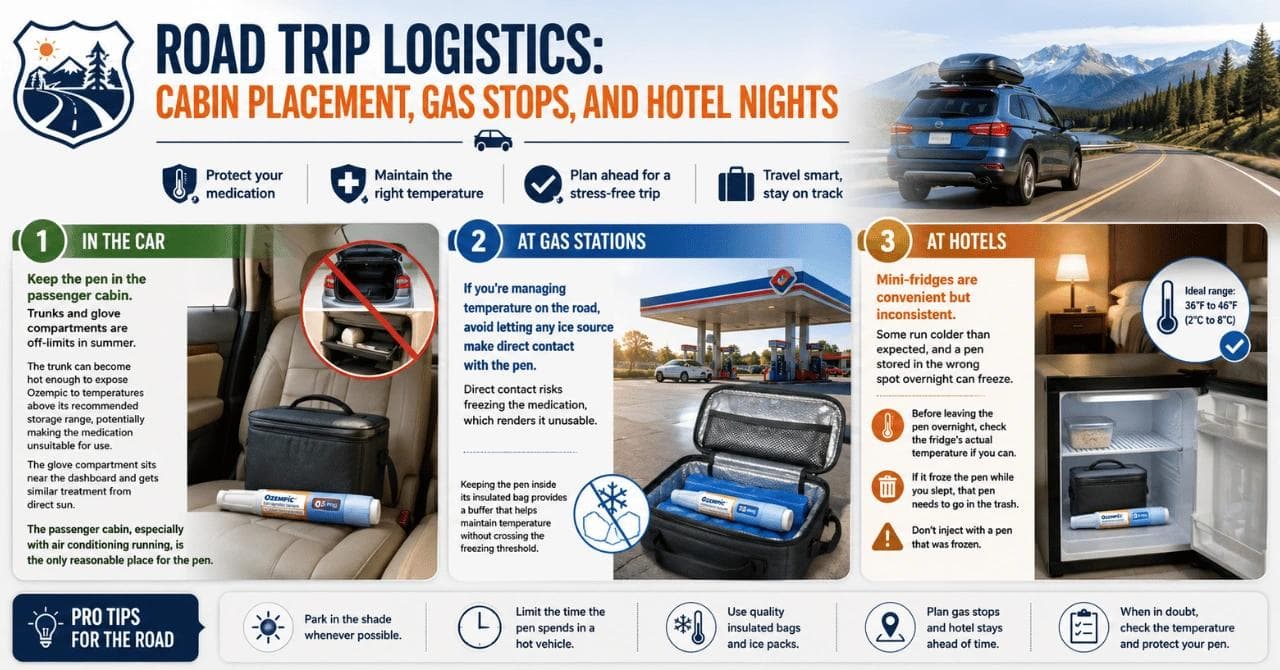
Road Trip Logistics: Cabin Placement, Gas Stops, and Hotel Nights
Every road trip with injectable medication requires planning for temperature control, storage, and easy access. Traveling with Ozempic pens means thinking through every environment the medication passes through, not just the car.
1. In the car: Keep the pen in the passenger cabin. Trunks and glove compartments are off-limits in summer. The trunk can become hot enough to expose Ozempic to temperatures above its recommended storage range, potentially making the medication unsuitable for use. The glove compartment sits near the dashboard and gets similar treatment from direct sun. The passenger cabin, especially with air conditioning running, is the only reasonable place for the pen.
2. At gas stations: If you're managing temperature on the road, avoid letting any ice source make direct contact with the pen. Direct contact risks freezing the medication, which renders it unusable. Keeping the pen inside its insulated bag provides a buffer that helps maintain temperature without crossing the freezing threshold.
3. At hotels: Mini-fridges are convenient but inconsistent. Some run colder than expected, and a pen stored in the wrong spot overnight can freeze. Before leaving the pen overnight, check the fridge's actual temperature if you can. If it froze the pen while you slept, that pen needs to go in the trash. Don't inject with a pen that was frozen.
If you're using an Ozempic prescription refilled through a licensed pharmacy, make sure you have enough supply before the trip. Running out on the road with no refill access is a harder problem than managing temperature.
Keeping Your Dosing Schedule on Track Across Time Zones
Semaglutide is injected on a recurring schedule, which gives it more flexibility than a daily medication. Some flexibility exists if a dose gets delayed during travel, but don't treat that as permission to be casual about it.
If you're unsure how to handle a schedule shift or a missed dose while traveling, contact your prescriber or pharmacist before making any changes. Getting pharmacy advice remotely is easier than managing a dosing error after the fact. Your prescriber's guidance on missed doses is the right reference point, not general advice from any article.
The Bottom Line on How to Travel with Ozempic
Traveling with Ozempic means matching your cooling solution to your actual trip. For short drives with an in-use pen, the 56-day room-temperature window may handle everything, as long as the car stays climate-controlled. For longer hauls or unopened pens, a dedicated medical cooler is worth the investment.
Simple habits cover most of the risk such as keeping the pen in the cabin, using your insulated bag at every stop, and checking the hotel mini-fridge temperature before leaving the pen overnight. None of this requires complicated planning. It just requires knowing the rules before you leave the driveway.
Patients who fill their semaglutide through a licensed Canadian pharmacy can also ask about cold-chain shipping options to ensure the medication arrives properly stored before the trip even begins.
Frequently Asked Questions
Keeping Ozempic in your carry-on bag is the safer choice. Cargo hold conditions can be unpredictable, and a pen that freezes is rendered unusable. This applies to both opened and unopened pens regardless of trip length.
When passing through airport security, medically necessary gel ice packs are generally permitted when declared. As of July 2026, TSA permits medically necessary gel ice packs through security checkpoints in any physical state, including frozen solid, slushy, or fully melted.
Refill access on the road can be complicated. Call your pharmacy before leaving to ask about your options, and carrying enough supply for the full trip is the simpler backup plan.
Used pens and needles require proper sharps disposal. Ask your pharmacist before you travel about how to locate appropriate disposal options along your route.
Disclaimer
This article covers general storage and travel information for Ozempic based on published guidelines, including FDA guidelines where applicable, but it is not a substitute for medical advice. Storage requirements and TSA rules for medication travel can change, and your specific situation may involve factors this article doesn't address. Talk to your doctor or pharmacist before traveling with any prescription medication, and always follow your prescriber's guidance on dosing.