Can You Take Mounjaro for Fatty Liver Disease? What You Need to Know
Key Takeaways
- As of 2026, Mounjaro is not FDA-approved specifically for MASLD/MASH, but growing clinical evidence suggests it may improve liver fat, inflammation, and fibrosis in eligible patients.
- The medication effectively reduces liver fat content and inflammation while promoting weight loss and improving overall metabolic health.
- Patients must undergo proper diagnostic testing, including blood work and imaging, before starting Mounjaro for fatty liver disease.
- Regular monitoring of liver function is required, and dosage must be escalated every four weeks under medical supervision.
- Complete alcohol abstinence is necessary while taking Mounjaro, as drinking can interfere with treatment effectiveness and liver healing.
Mounjaro (tirzepatide) continues to show promising results for metabolic dysfunction-associated steatotic liver disease (MASLD), including metabolic dysfunction-associated steatohepatitis (MASH). Although Mounjaro is FDA-approved for type 2 diabetes, not fatty liver disease, recent clinical evidence suggests it may reduce liver fat, improve liver inflammation, and support weight loss in eligible patients.
What Is MASLD, and How Does It Differ From MASH? (Previously Called NAFLD and NASH)
As medical understanding of liver diseases continues to evolve, fatty liver disease has emerged as a significant health concern affecting millions worldwide. Now known as metabolic dysfunction-associated steatotic liver disease, this condition occurs whenever excess fat accumulates in the liver, often due to obesity and Insulin resistance is a significant factor contributing to fatty liver disease. Previously known as NAFLD and NASH, these conditions are now referred to as MASLD and MASH. MASLD describes fat accumulation in the liver related to metabolic dysfunction, while MASH is the progressive form involving liver inflammation and injury. Both conditions are strongly linked to weight loss resistance and metabolic disorders, affecting liver function and overall health.
Is Mounjaro a Safe Medication Option for Treating Fatty Liver Disease?
As of 2026, Mounjaro remains FDA-approved only for improving blood sugar control in adults with type 2 diabetes. It is not FDA-approved specifically for MASLD or MASH, so its use for fatty liver disease is considered off-label.
Recent clinical trials have revealed promising safety and efficacy data for Mounjaro (tirzepatide) in treating fatty liver disease, with 74% of patients achieving MASH resolution during Phase 2 studies.
While the medication shows significant potential, healthcare providers must carefully consider safety considerations and monitoring recommendations. Key safety aspects include:
- Regular monitoring for thyroid tumors, pancreatitis, and gallbladder disease
- Common side effects: nausea, diarrhea, vomiting, and constipation
- Serious side effects: potential risk of pancreatitis, hypoglycemia, and thyroid cancer
Additional safety considerations in 2026 include delayed stomach emptying, dehydration that may lead to kidney problems, and severe gastrointestinal side effects in some patients. Patients should also tell their healthcare provider if they have surgery planned, since temporary treatment adjustments may be recommended before certain procedures.
The weekly injectable medication requires dose escalation every four weeks, with ongoing liver function monitoring throughout treatment. Treatment usually starts at 2.5 mg once weekly, with gradual dose increases every four weeks until the recommended maintenance dose is reached, depending on individual tolerability and treatment goals. Patients with a history of pancreatitis require special consideration since this population wasn’t included in clinical trials. Despite these considerations, Mounjaro’s strong efficacy data suggest it could become a valuable treatment option whenever properly monitored.
How Does Mounjaro Work for People with MASLD or MASH?
Based on extensive clinical research, Mounjaro (tirzepatide) demonstrates remarkable effectiveness in treating MASLD and MASH through multiple therapeutic pathways. The medication considerably reduces liver fat and inflammation while simultaneously addressing metabolic dysfunction-associated steatotic liver disease.
As of 2026, tirzepatide is marketed under two brand names in the United States: Mounjaro for type 2 diabetes and Zepbound for chronic weight management and certain adults with obstructive sleep apnea. Because excess weight is a major driver of MASLD/MASH, the weight loss achieved with tirzepatide may also contribute to improvements in liver health.
Clinical trials reveal that Mounjaro can improve and potentially reverse fatty liver conditions. Up to 62% of patients experienced MASH resolution and significant reductions in liver fat in clinical studies. The drug’s ability to stabilize fibrosis and prevent disease progression makes it particularly valuable for NASH treatment. Beyond its direct effects on liver function, Mounjaro promotes weight loss and boosts metabolic health, creating a thorough approach to managing liver disease. Trial results consistently show superior outcomes compared to placebo, with notable reductions in liver fat content across various dosage levels.
Steps to Diagnose Fatty Liver Disease Before Considering Mounjaro
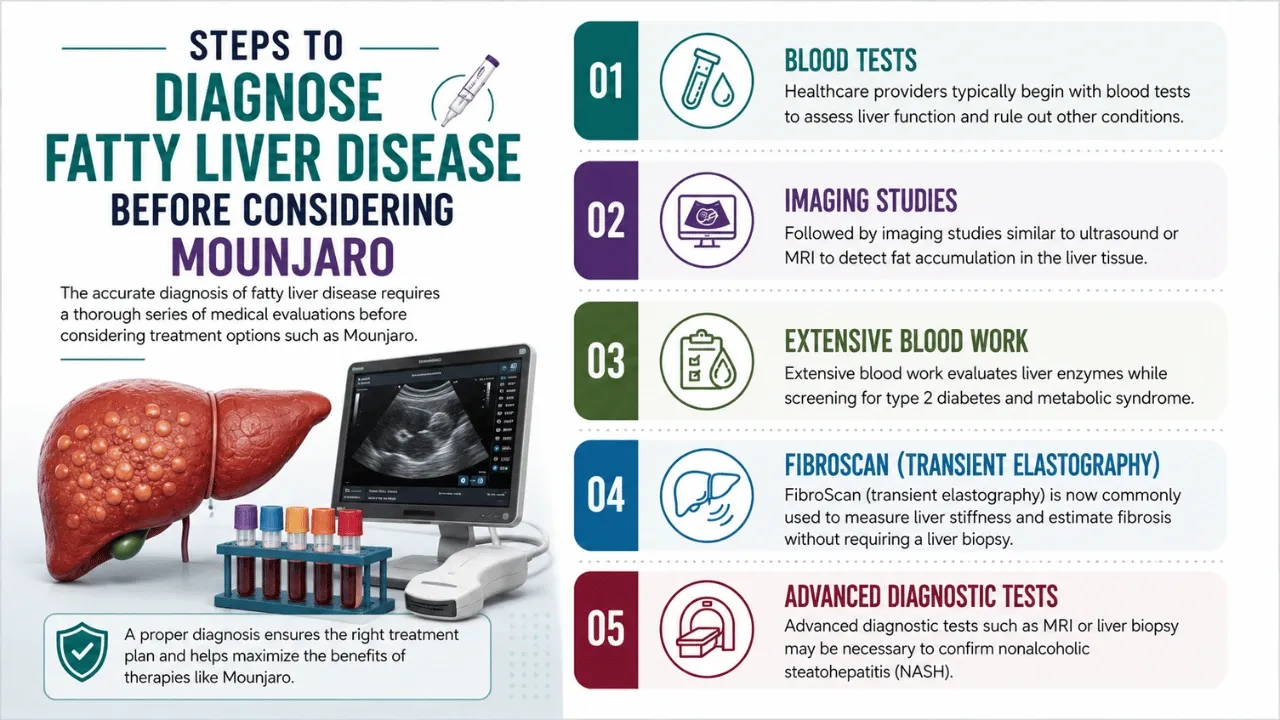
The accurate diagnosis of fatty liver disease requires a thorough series of medical evaluations before considering treatment options such as Mounjaro. Healthcare providers typically begin with blood tests to assess liver function and rule out other conditions, followed by imaging studies similar to ultrasound or MRI to detect fat accumulation in the liver tissue.
- Extensive blood work evaluates liver enzymes while screening for type 2 diabetes and metabolic syndrome.
- Imaging tests, particularly ultrasound, can detect fatty liver whenever steatosis reaches 30% or higher.
- FibroScan (transient elastography) is now commonly used to measure liver stiffness and estimate fibrosis without requiring a liver biopsy.
- Advanced diagnostic tests such as MRI or liver biopsy may be necessary to confirm nonalcoholic steatohepatitis (NASH).
Lifestyle factors and risk indicators, including obesity and high triglycerides, play essential roles in the diagnostic process. These evaluations help determine the severity of fatty liver disease and guide appropriate treatment strategies.
The Role of Alcohol Use in Fatty Liver Disease and Its Impact on Mounjaro Treatment
Understanding alcohol’s pivotal role in fatty liver disease becomes essential upon considering treatment options such as Mounjaro since alcohol consumption considerably impacts liver health and treatment outcomes. While Mounjaro and alcohol don’t directly interact, alcohol consumption can greatly hinder treatment success by increasing liver inflammation and compromising metabolic health.
Even moderate drinking can double the risk of advanced liver damage in those with nonalcoholic fatty liver disease. To optimize Mounjaro treatment and support liver health, patients should avoid alcohol completely. Alcohol not only interferes with weight loss goals but can also lead to dangerous blood sugar fluctuations. For those pursuing lasting improvements in liver health, abstaining from alcohol allows the liver to heal while maximizing the benefits of Mounjaro therapy. In 2026, healthcare providers continue to recommend avoiding alcohol completely whenever possible to support liver healing and maximize treatment benefits.
Key Take-Home Messages About Using Mounjaro for Fatty Liver Disease
Recent clinical evidence demonstrating Mounjaro’s remarkable effectiveness in treating fatty liver disease has established several essential takeaway points for patients and healthcare providers. Studies show that tirzepatide significantly reduces liver fat content, improves liver function, and addresses metabolic dysfunction-associated steatohepatitis (MASH).
- Nearly 74% of patients achieved MASH clearance with Mounjaro treatment, marking a breakthrough in managing liver inflammation and fibrosis.
- The dual-action mechanism targeting GIP and GLP-1 receptors promotes sustainable weight loss while reducing liver fat accumulation.
- Patients experience multiple metabolic benefits beyond liver health, including improvements in blood pressure, cholesterol, and blood sugar control.
These findings position Mounjaro as a promising therapeutic option for those seeking liberation from fatty liver disease and its complications.
Consulting Your Healthcare Provider: Is Mounjaro Right for Your Fatty Liver?
Deciding whether Mounjaro could be an appropriate treatment for fatty liver disease requires careful consultation with qualified healthcare providers who can evaluate individual patient circumstances and medical histories. Healthcare providers assess liver function through thorough testing and consider clinical trial data showing Mounjaro’s significant impact on reducing liver fibrosis. They evaluate factors including current medications, weight loss goals, and the presence of metabolic syndrome when making treatment recommendations. Regular monitoring guarantees ideal outcomes, as demonstrated by studies showing that 74% of patients achieved MASH resolution with Mounjaro treatment. Healthcare providers offer personalized advice based on individual health profiles and potential benefits, weighing promising research results against patient-specific factors. This collaborative approach helps determine if Mounjaro aligns with a patient’s liver health objectives and overall treatment plan.
Bottom Line: Can Mounjaro Help Fatty Liver Disease in 2026?
Current evidence suggests Mounjaro may reduce liver fat, improve MASH, and support meaningful weight loss, but it is not FDA-approved specifically for fatty liver disease. If you have MASLD or MASH, your healthcare provider can determine whether tirzepatide is an appropriate treatment based on your overall health and medical history.
Frequently Asked Questions
Clinical studies have shown significant reductions in liver fat and high rates of MASH resolution after about 52 weeks of treatment. Individual results vary, and not everyone experiences complete disease resolution.
Mounjaro can often be used alongside other liver medications, but your healthcare provider should review all prescription and over-the-counter medicines before treatment begins.
Missed dose within 4 days:
- Take a shot right away
- Go back to normal schedule
Missed dose past 4 days:
- Skip missed shot
- Wait for the next planned shot
That’s it. Stay on a weekly schedule after getting back on track.
As of 2026, Mounjaro is generally not covered by insurance when prescribed only for fatty liver disease because it is not FDA-approved for this use. However, coverage may be available for people with type 2 diabetes who meet their insurer's prior authorization requirements. Benefits vary by insurance plan.
Most healthcare providers recommend a Mediterranean-style eating pattern that emphasizes vegetables, lean protein, whole grains, healthy fats, and limited added sugars. If Mounjaro causes stomach upset, temporarily reducing very high-fiber or greasy foods may improve tolerability.